How to Make a Quilt Longer but Not Wider: 4 Ways, Worked Out in Inches and cm
To make a quilt longer but not wider, add length at the top and bottom edges only and leave the sides alone. There are four ways to do it. Sew borders to the top and bottom only. Add another row of blocks, or two. Mix one row with narrower borders. Or sew a band across the head end for a pillow tuck. Each border piece is cut ½ in (1.3 cm) wider than it finishes, and as long as the top is wide plus ½ in.
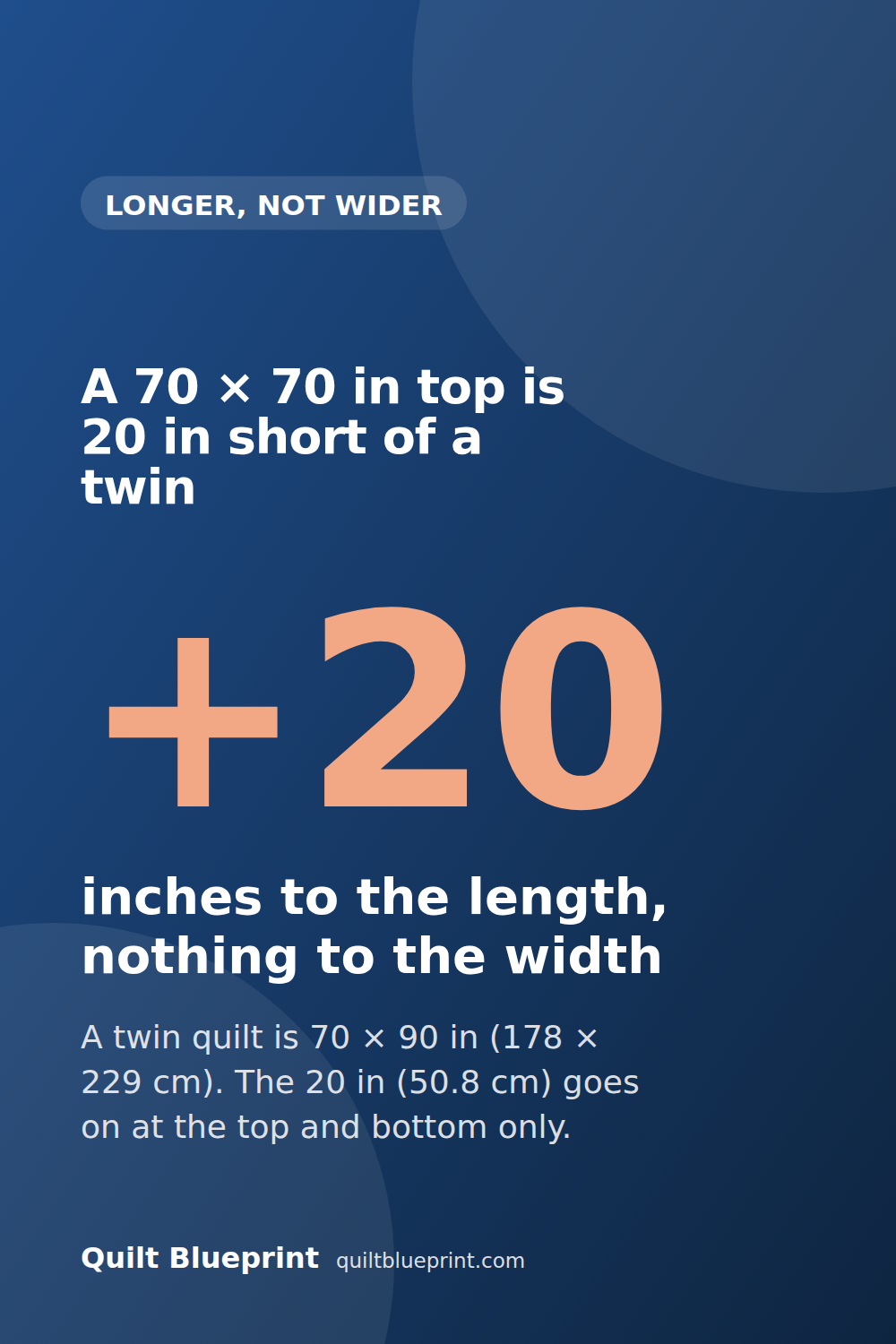
One example runs through the whole post. It's a top of 49 blocks, 7 across and 7 down, each 10 in (25.4 cm) finished, so it's 70 × 70 in (178 × 178 cm). The goal is a twin, which the quilt size chart lists at 70 × 90 in (178 × 229 cm).
How much longer does your quilt need to be?
Start with the length you want, then take away the length you have. That gap is the one number every way below has to add. Here are the standard bed quilt sizes, and the length each one becomes with a 10 in (25.4 cm) pillow tuck.
| Bed quilt | Its size | Length with a pillow tuck |
|---|---|---|
| Twin | 70 × 90 in (178 × 229 cm) | 100 in (254 cm) |
| Twin XL | 70 × 95 in (178 × 241 cm) | 105 in (267 cm) |
| Full / Double | 84 × 90 in (213 × 229 cm) | 100 in (254 cm) |
| Queen | 90 × 95 in (229 × 241 cm) | 105 in (267 cm) |
| King | 108 × 95 in (274 × 241 cm) | 105 in (267 cm) |
| California King | 104 × 100 in (264 × 254 cm) | 110 in (279 cm) |
For your own bed, the length is the mattress, plus the drop at the foot, plus the tuck if you want one. A queen mattress is 80 in (203.2 cm) long. A 12 in (30.5 cm) drop covers a standard mattress, so with a tuck that's 80 + 12 + 10 = 102 in (259 cm).
Measure your top flat on the floor, through the middle, not along an edge. Edges stretch as a top gets handled, and a gap worked out from a stretched edge comes up short. For the example, 90 − 70 = 20 in (50.8 cm).
1. Borders on the top and bottom only
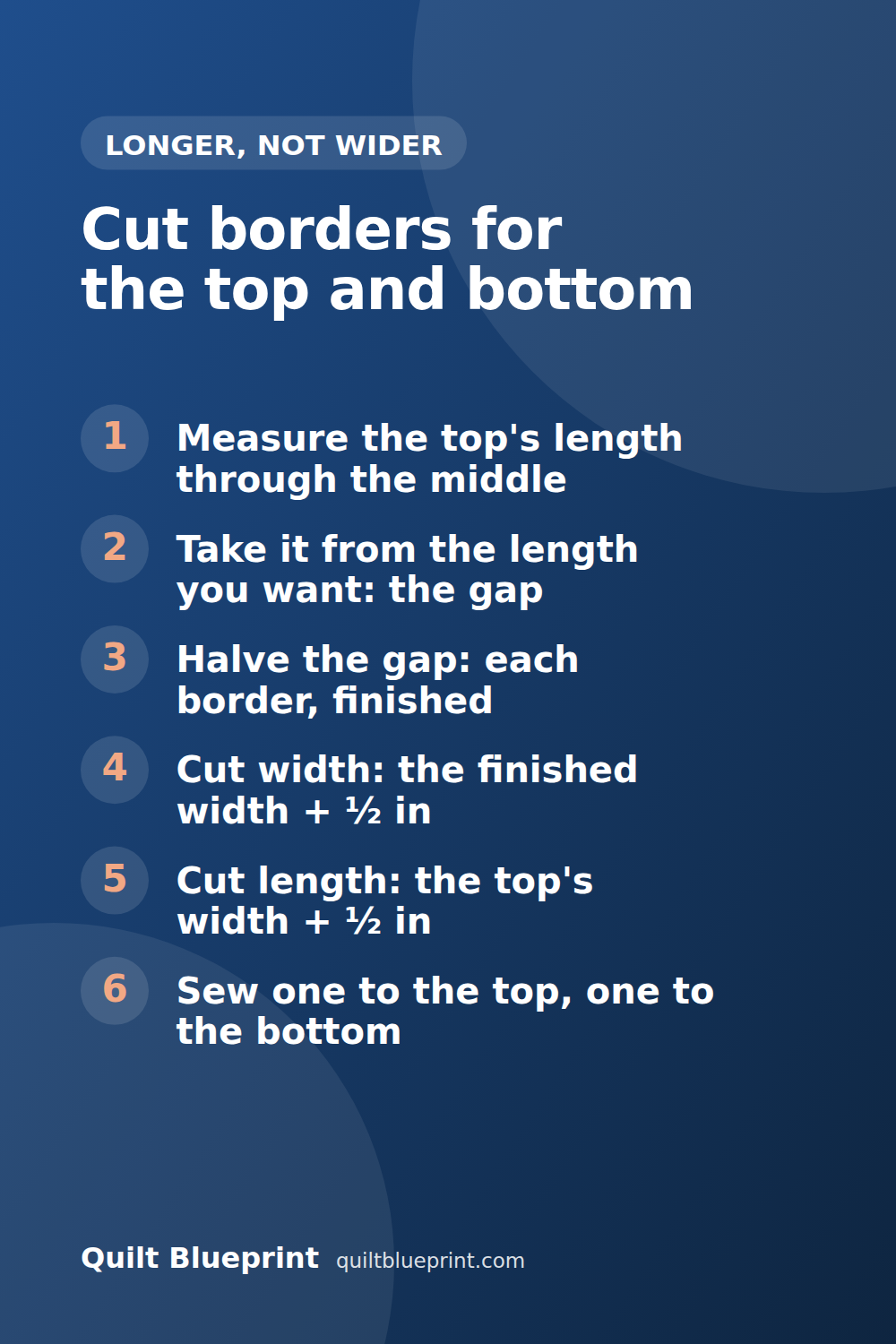
This is the fastest way. Split the gap in two, put one border at each end, and sew nothing to the sides. Here's the whole sum:
- Each border, finished = the gap ÷ 2.
- Cut width = the finished width + ½ in (1.3 cm), a ¼ in seam on each long edge.
- Cut length = the top's width, measured through the middle, + ½ in, which leaves a little to square up.
For the example, each border finishes at 10 in (25.4 cm). Cut two pieces 10½ × 70½ in (26.7 × 179.1 cm).
Each piece is longer than one strip cut across 42 in (107 cm) quilting cotton, so you join two strips end to end. Allow ½ in for each join, which leaves 41½ in of usable length a strip. Two pieces 70½ in long take four strips. Four strips 10½ in wide use 42 in of fabric, so you buy 1¼ yd (1.1 m).
It works, but a 10 in border at each end is heavy on a quilt made of 10 in blocks. With nothing on the sides, it can look like a frame that forgot two of its edges. If that bothers you, the next two ways split the length differently.
2. One or two more rows of blocks
If you can make more blocks, each row adds exactly one finished block to the length and nothing to the width. Rows to add = the gap ÷ the finished block size.
For the example, 20 ÷ 10 = 2 rows. That's 7 + 7 = 14 more blocks, and the top becomes 70 × 90 in (178 × 229 cm), a twin. When the sum doesn't come out whole, add the whole rows that fit and make up the rest with borders, which is way 3.
Plain squares for a 10 in block are cut at 10½ in (26.7 cm), and four of them fit across a 42 in strip. Fourteen take four strips, or 42 in of fabric, which is 1¼ yd (1.1 m) if one fabric made them all. A pieced block has its own cutting list. The block pages give the pieces for each traditional block, and the Nine Patch is a good one to read if you've never cut for a block.
Remember the cut size isn't the size a row adds. A row of blocks cut at 10½ in tall adds 10 in, because the seams take the other ½ in.
If your blocks have sashing between them, a row adds the block plus one strip of sashing. With 2 in (5.1 cm) sashing, each new row adds 12 in (30.5 cm), so two rows would add 24 in, and you'd overshoot a twin by 4 in.
Two rows at the bottom, or one at each end? If the quilt has a centre the eye goes to, like a big star, put one row at each end so the centre stays in the middle. On an all-over layout, it doesn't matter.
3. One row of blocks plus narrower borders
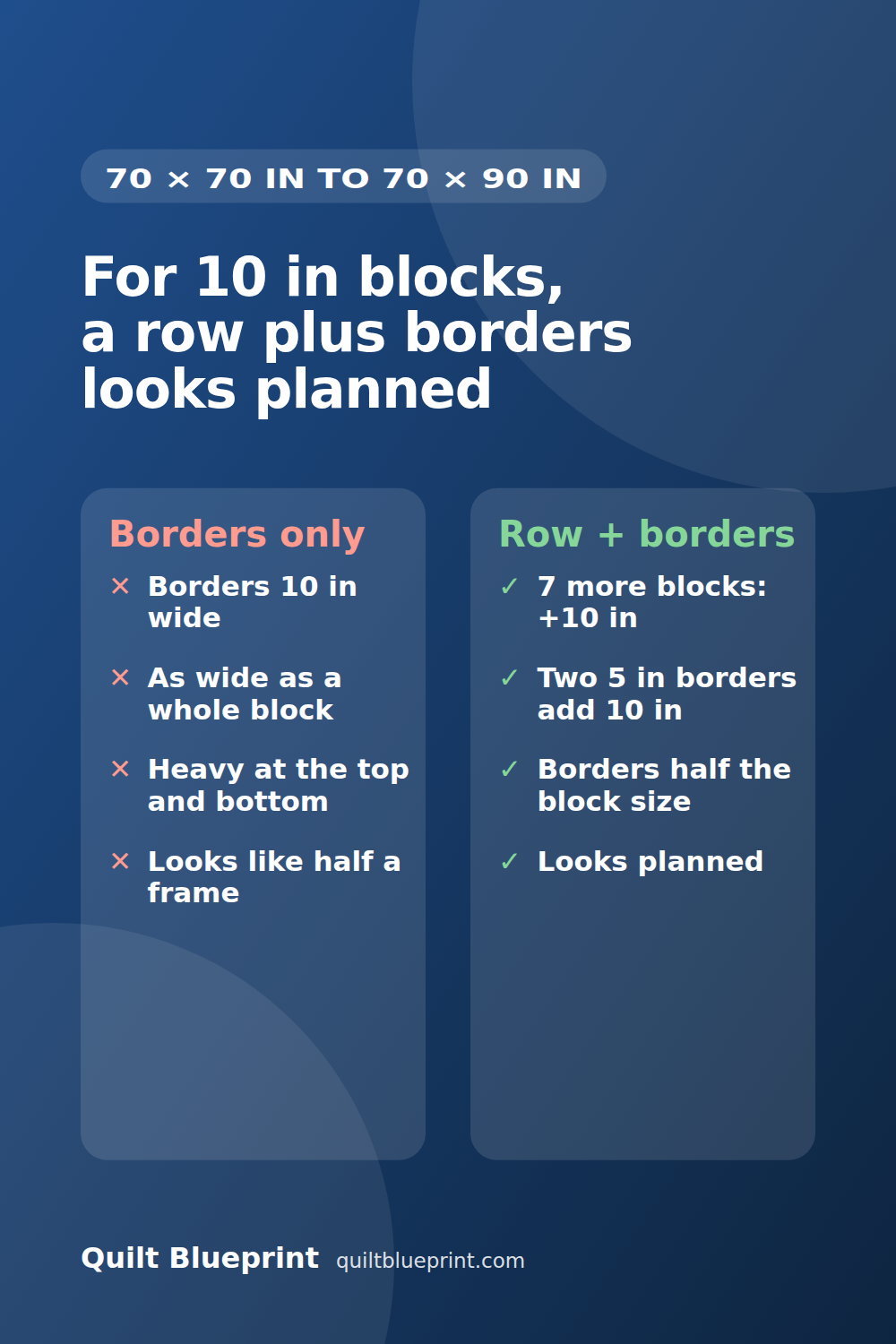
This is the best fit for the example. One row of 7 blocks adds 10 in. The other 10 in goes into two borders of 5 in (12.7 cm) finished, one at each end.
Cut the borders 5½ × 70½ in (14 × 179.1 cm). That's four strips 5½ in wide again, 22 in of fabric, so you buy ⅝ yd (0.6 m). The seven blocks, if they're plain squares from one fabric, take two strips and ⅝ yd (0.6 m) more.
You sew 7 blocks instead of 14, and the borders end up half the block size, which looks planned. It also works when the gap isn't a whole number of blocks. Say your gap is 15 in with 10 in blocks: one row, then two borders of 2½ in (6.4 cm), cut 3 × 70½ in.
4. A band at the head for a pillow tuck
If the quilt covers the bed but stops short of the pillows, you only need length at one end. A pillow tuck is about 10 in (25.4 cm) of extra length that folds under and over the pillows.
So sew one band across the head end and nothing at the foot. A queen is 90 × 95 in (229 × 241 cm). With a band that finishes at 10 in, it becomes 90 × 105 in (229 × 267 cm).
Cut the band 10½ × 90½ in (26.7 × 229.9 cm). That's three strips joined end to end, 31½ in of fabric, so you buy ⅞ yd (0.9 m). The metric rounds up a step because 31½ in is just over 80 cm, and shops cut by the 10 cm.
The band can be the border fabric or a plain one, since it spends most nights folded under a pillow. Pin a note to the head end before it goes to be quilted. A quilt that's longer at one end looks the same either way up until it's on the bed.
Should a quilt be longer or wider?
Longer, for most beds. A twin is 70 × 90 in, a full 84 × 90 in and a queen 90 × 95 in, all longer than they're wide, because the mattress is.
A king turns that round. At 108 × 95 in (274 × 241 cm) it's wider than it is long, because a king mattress is 76 in (193 cm) wide and only 80 in (203.2 cm) long, and the quilt hangs over both sides as well as the foot. A California king, 104 × 100 in (264 × 254 cm), is wider than long too.
So check which way your top runs before you add anything. A top that measures 70 in one way and 90 the other is already a twin. Turn it.
What a longer top changes: the backing, batting and binding
A longer top needs a longer back, a bigger batt and a little more binding. Here's the example before and after, at 4 in (10.2 cm) of extra backing and batting on every side, the amount a longarm quilter asks for:
- Backing: 78 × 78 in becomes 78 × 98 in (198 × 249 cm). In 42 in fabric that's 4⅜ yd (4 m) before and 5½ yd (5 m) after: two widths, with the seam running down the quilt.
- Batting: 78 × 98 in no longer fits a full package, which is 81 × 96 in. It takes a queen package, 90 × 108 in (229 × 274 cm).
- Binding: 330 in (838.2 cm) of binding instead of 290 in (736.6 cm), the edge plus 10 in for the corners and the join. That's 9 strips of 2½ in instead of 8, still ⅝ yd (0.6 m).
The backing calculator, batting calculator and binding calculator take the new size and give you the rest. Work them out before you buy the border fabric, so it can all go on one trip.
Already quilted? Add a quilted band
It's much easier before the quilt is layered, but a finished quilt can be made longer too. Take the binding off the end you're adding to. Cut a strip for the front, one for the back and one of batting, each the band's width + ½ in. Sew all three to the edge in one seam, through every layer, fold them out flat, and quilt the band to match. Then bind it again.
The binding has to be long enough for the new edge. For the twin above, that's the 330 in from the list, so if you have none of the old binding fabric left, plan on a new binding all round.
Three ways a longer quilt goes wrong
Adding to the width by accident. A border all round adds twice its width to the width too. Five-inch borders on every side make the 70 × 70 in top 80 × 80 in (203 × 203 cm): 10 in longer and 10 in wider. Only borders on the top and bottom add length alone.
Counting the cut size of a row. A row of 10 in blocks is cut at 10½ in and adds 10 in. Plan with 10½ and every row you add puts the quilt ½ in further off.
Buying the backing for the old size. The back grows with the top. For the example, it's 1⅛ yd more, and the batting goes up a package size.
Questions people ask
Can adding borders make a quilt bigger?
Yes. A border adds its finished width to every edge it touches. Two 5 in (12.7 cm) borders on the top and bottom add 10 in to the length and nothing to the width; the same borders on all four sides add 10 in to both.
Should a quilt be longer or wider?
Longer for a twin, full or queen: 70 × 90, 84 × 90 and 90 × 95 in. Wider for a king, 108 × 95 in (274 × 241 cm), and a California king, 104 × 100 in, because their mattresses are wide and the quilt hangs over both sides.
How do you extend a quilt?
Before it's quilted, sew borders or rows of blocks to the edges you need: the top and bottom for length, the sides for width. After it's bound, take the binding off that edge, add a band of top fabric, batting and backing in one seam, quilt it and bind it again.
Sources
- Quilt size chart: standard quilt sizes, mattress sizes, drop and pillow tuck (Quilt Blueprint, read 2026-11-08)
- Quilt backing calculator: 4 in a side, ½ in seams and yardage (Quilt Blueprint, read 2026-11-08)
- Quilt batting calculator: packaged batting sizes (Quilt Blueprint, read 2026-11-08)
- Quilt binding calculator: 2½ in strips, the edge plus 10 in (Quilt Blueprint, read 2026-11-08)
- How to make a quilt bigger: borders on the top and bottom only, sashing, more blocks (Chicken Scratch NY, read 2026-11-08)
- Enlarging a finished quilt: the binding off, a front, batting and back strip sewn through all layers (Chris Quilts, read 2026-11-08)
Keep reading
Quilt Backing Fabric Not Wide Enough? 5 Fixes, Worked Out in Inches and cm
Quilt backing fabric not wide enough? Add a strip 1 in wider than the gap, turn the seams, cut less extra or use 108 in backing. Every sum in inches and cm.
What Size Quilt Can You Make With a Layer Cake? Every Bed Size, in Inches and cm
What size quilt can you make with a layer cake? One 42-square stack makes a 57 × 66½ in throw. How many layer cakes each bed size takes, in inches and cm.
What Size Quilt for a Bunk Bed? Top and Bottom Bunk Sizes in Inches and cm
What size quilt for a bunk bed: a top bunk takes the mattress, its depth and a short tuck, about 58 × 85 in. Top and bottom bunk charts in inches and cm.