What Size Quilt for a Bunk Bed? Top and Bottom Bunk Sizes in Inches and cm
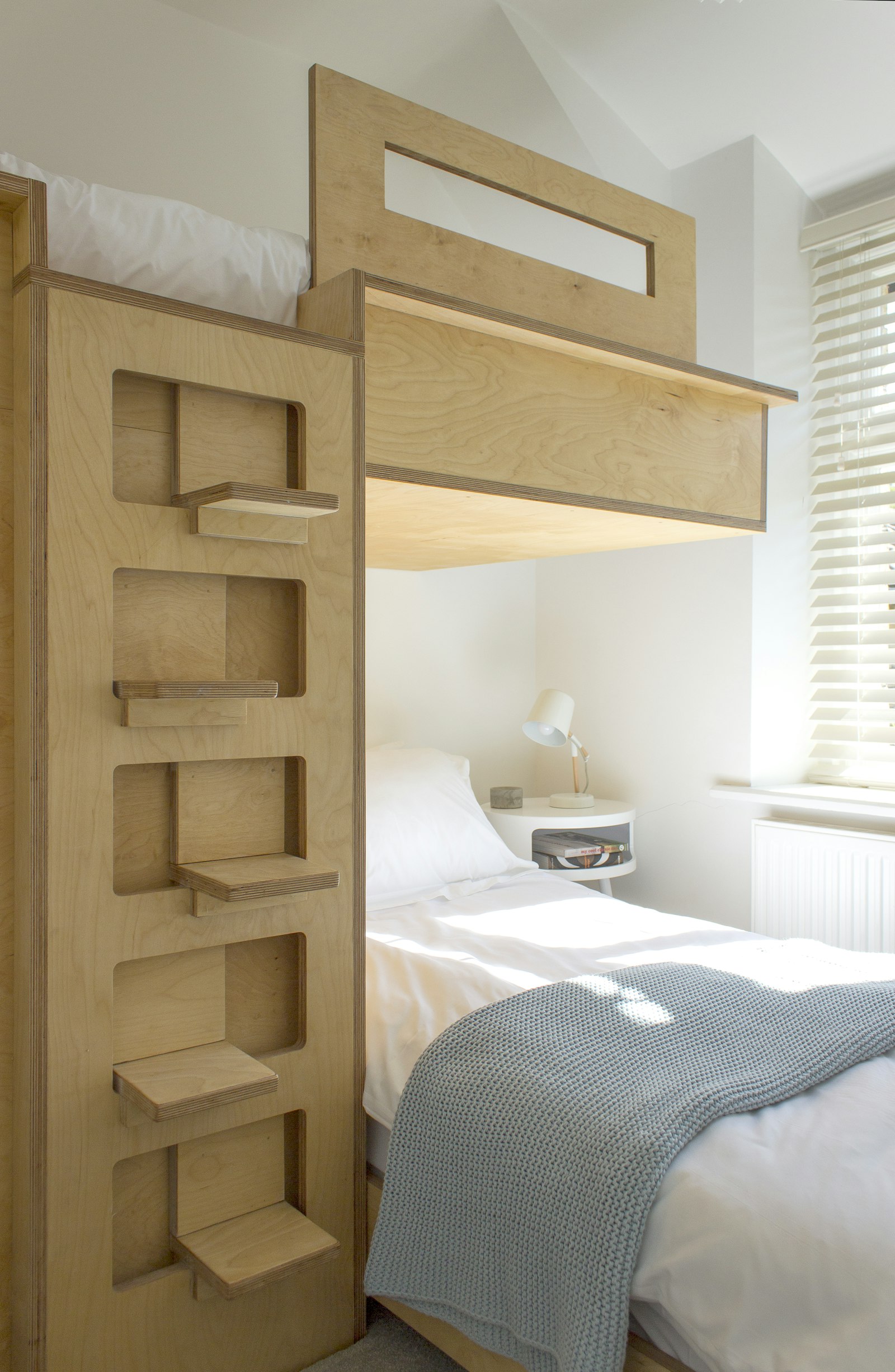
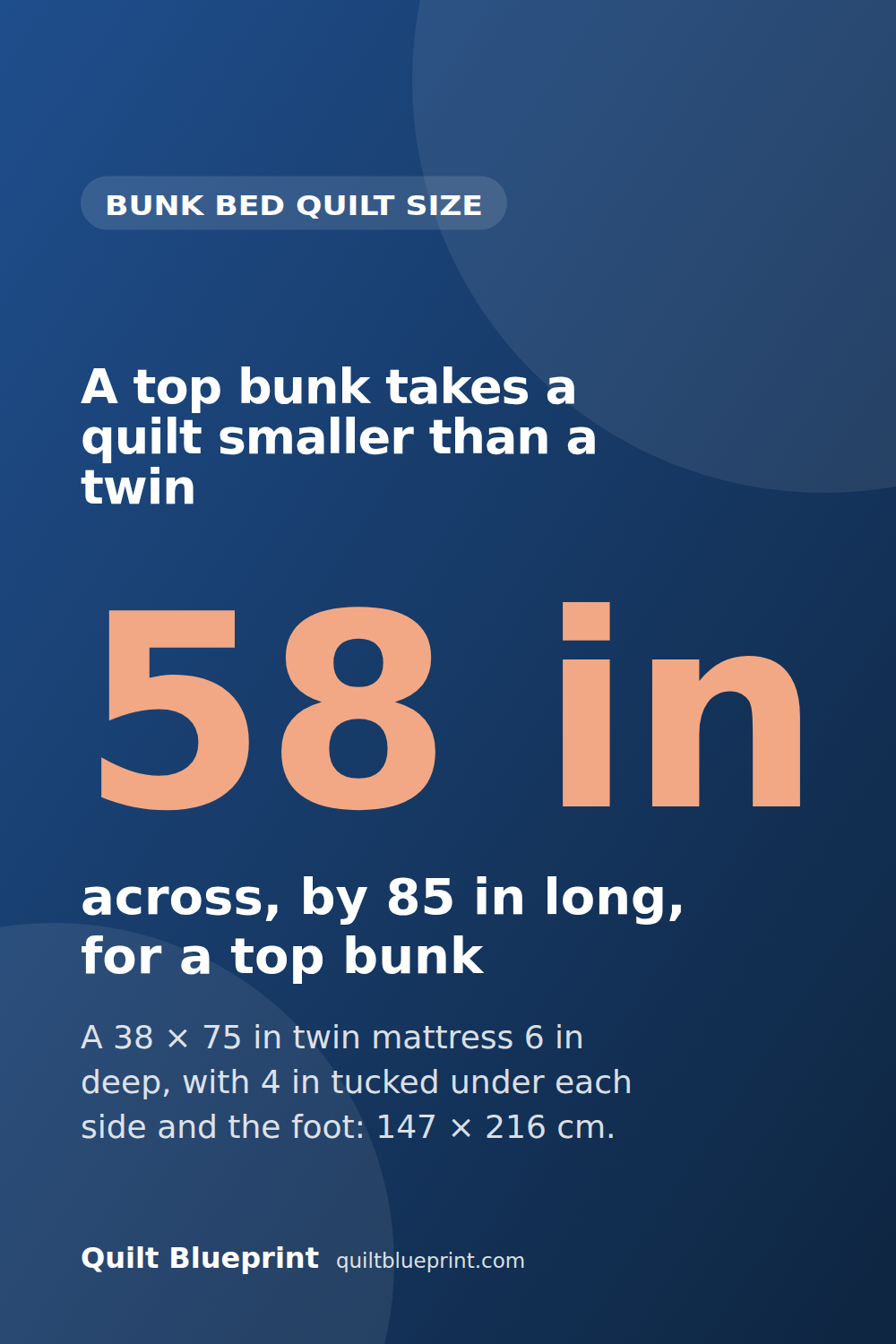
A quilt for a top bunk with a 6 in (15 cm) twin mattress is 58 × 85 in (147 × 216 cm). That covers the mattress top, runs down its 6 in sides, and tucks 4 in (10 cm) under each side and the foot. It's smaller than a twin quilt on purpose. A top-bunk mattress sits inside guardrails and a frame, so a long drop has nowhere to hang. The bottom bunk has more room: with a 12 in (30.5 cm) drop, it takes 62 × 87 in (157 × 221 cm).
Most bunk beds hold a standard twin mattress, 38 × 75 in (97 × 191 cm), and bunk mattresses are often thinner than a regular bed's, around 6 to 8 in (15 to 20 cm) deep. On a top bunk that depth matters most, because it's most of the drop.
Why a twin quilt is too big for a top bunk
A twin bed quilt is 70 × 90 in (178 × 229 cm). On a twin mattress, it hangs 16 in (40.6 cm) down each side and 15 in (38.1 cm) at the foot. That's right for a bed with open sides, where the quilt falls toward the floor. Every standard size is in the quilt size chart.
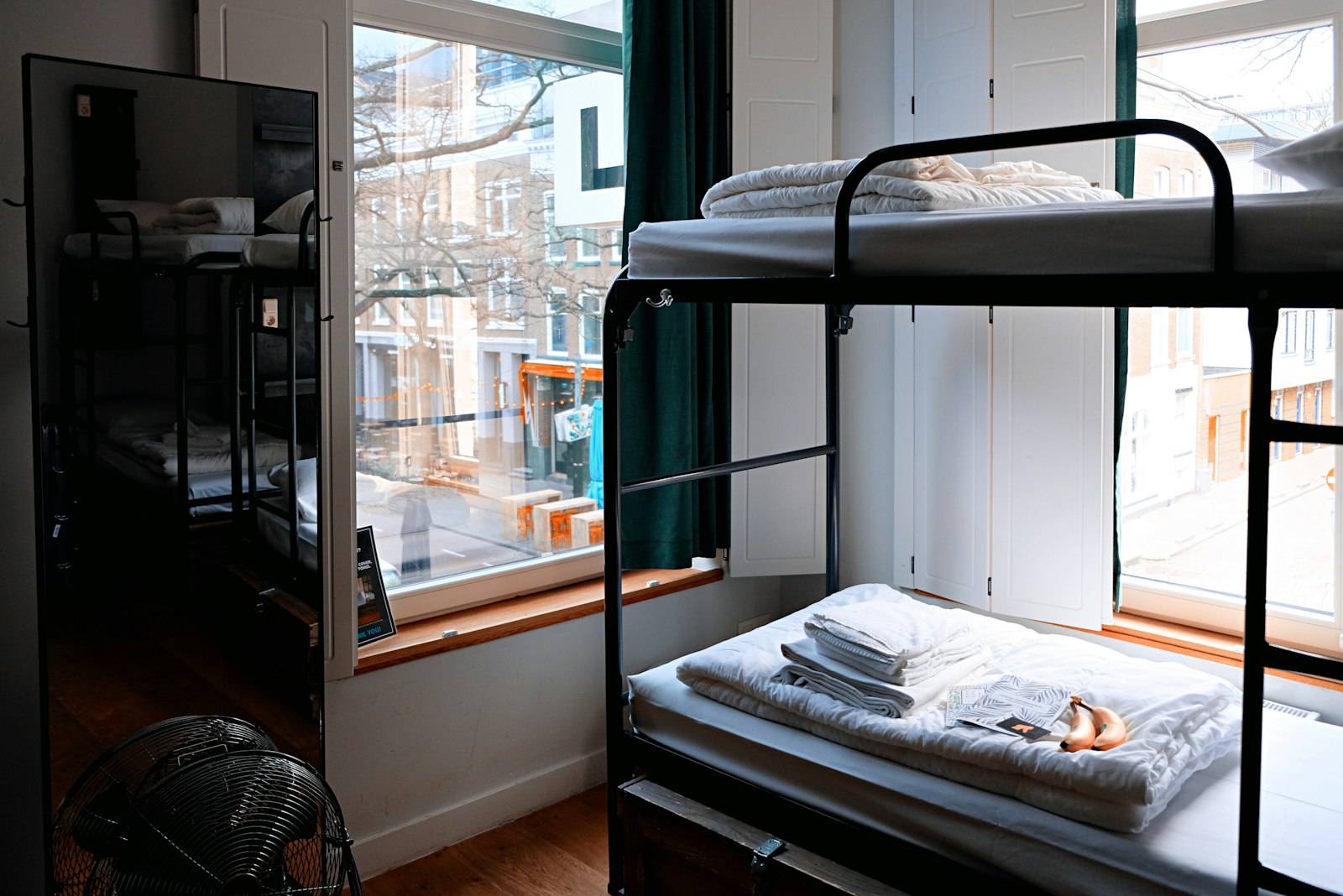
A top bunk is boxed in. It has a guardrail on each side, and the tops of those rails have to stand at least 5 in (12.7 cm) above the mattress. The ends of the bunk rise above it as well. So the mattress sits in a tray, and a 16 in drop has nowhere to fall. It gets stuffed down between the mattress and the rail, or it drapes over the rail and hangs outside the bed.
With a 6 in mattress, a twin quilt carries 10 in (25.4 cm) more than it needs on each side, and the foot has the same extra. That's a lot of quilt to wrestle with from a ladder, every single morning.
Is a bunk bed a twin or a twin XL?
Most bunk beds take a standard twin mattress, 38 × 75 in (97 × 191 cm). Some are made for a twin XL, 38 × 80 in (97 × 203 cm), which is 5 in (12.7 cm) longer. A twin-over-full bunk has a twin on top and a full, 54 × 75 in (137 × 191 cm), underneath, so its two quilts can't be the same size.
Measure the mattress, not the frame, and measure its depth while the tape's out. On a top bunk the depth is most of the drop, so it changes the quilt more than anything else does.
The depth has a ceiling, too. The guardrails must stand at least 5 in above the mattress, and that's checked with the thickest mattress the maker recommends for that bed. A deeper mattress eats into that margin. So the bunk's own instructions decide how deep the mattress can be, and the quilt follows the mattress.
The top bunk quilt sum
Quilt Blueprint sizes a bed quilt as the mattress, plus a drop down each side, plus the same drop at the foot. On a top bunk, the drop is just the mattress depth plus a short tuck:
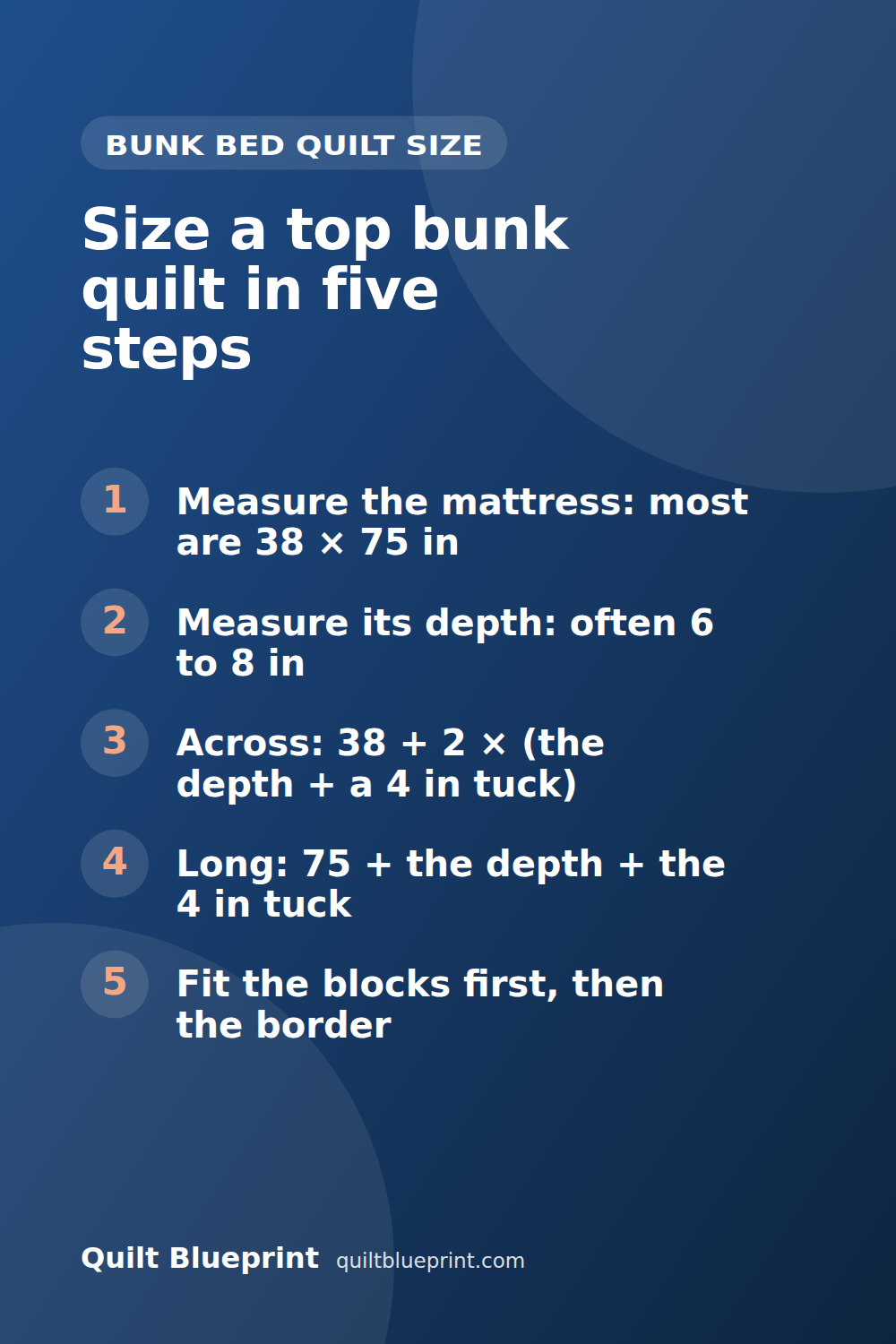
- Across = the mattress width + 2 × (the depth + the tuck). For a 6 in mattress and a 4 in tuck: 38 + 2 × 10 = 58 in (147 cm).
- Long = the mattress length + the depth + the tuck. For the same bunk: 75 + 10 = 85 in (216 cm).
The 4 in (10.2 cm) tuck folds under the edge of the mattress, which keeps the quilt in place when someone climbs in and out. The foot gets the same tuck. There's no pillow tuck in the sum, because the head end of the bunk sits right behind the pillow. If you'd like one anyway, add 10 in (25.4 cm) to the length.
Top bunk quilt sizes by mattress depth
Here's the sum for each common bunk mattress depth. All four keep the 4 in (10.2 cm) tuck, so every extra inch of mattress adds 2 in across and 1 in to the length.
| Mattress depth | Drop each side and foot | Top bunk quilt |
|---|---|---|
| 5 in (12.7 cm) | 9 in (22.9 cm) | 56 × 84 in (142 × 213 cm) |
| 6 in (15.2 cm) | 10 in (25.4 cm) | 58 × 85 in (147 × 216 cm) |
| 7 in (17.8 cm) | 11 in (27.9 cm) | 60 × 86 in (152 × 218 cm) |
| 8 in (20.3 cm) | 12 in (30.5 cm) | 62 × 87 in (157 × 221 cm) |
For a twin XL top bunk, keep the width and add 5 in (12.7 cm) to the length: a 6 in XL mattress takes 58 × 90 in (147 × 229 cm). Bedding sold for top bunks follows the same idea: about 8 to 10 in (20 to 25 cm) past the mattress edge on each side, enough to tuck and no more.
What size quilt for the bottom bunk?
The bottom bunk is freer. The safety rule that puts guardrails on a top bunk doesn't ask for them on a lower bunk whose base sits 30 in (76 cm) or less off the floor. So its open side can hang like an ordinary bed, and only the ends box it in.
How long a drop? Hold the tape at the top edge of the mattress and measure down to where you'd like the quilt to stop, short of the floor. Here are the sizes for a 10, 12 and 14 in drop, on a twin bottom bunk and on the full under a twin-over-full:
| Bottom bunk mattress | Drop | Quilt |
|---|---|---|
| Twin, 38 × 75 in | 10 in (25.4 cm) | 58 × 85 in (147 × 216 cm) |
| Twin, 38 × 75 in | 12 in (30.5 cm) | 62 × 87 in (157 × 221 cm) |
| Twin, 38 × 75 in | 14 in (35.6 cm) | 66 × 89 in (168 × 226 cm) |
| Full, 54 × 75 in | 10 in (25.4 cm) | 74 × 85 in (188 × 216 cm) |
| Full, 54 × 75 in | 12 in (30.5 cm) | 78 × 87 in (198 × 221 cm) |
| Full, 54 × 75 in | 14 in (35.6 cm) | 82 × 89 in (208 × 226 cm) |
If the bottom bunk stands against a wall, that side only needs a tuck. You can still make it the same size: the extra slips down between the mattress and the wall. And if the drop you measured is 16 in (40.6 cm) or more, an ordinary 70 × 90 in twin quilt fits the bottom bunk just fine.
One block layout for both bunks
Making a matching pair? Plan both quilts from the same blocks and let the border do the fitting. With a 9 in (22.9 cm) block, Quilt Blueprint fits 6 across and 9 down, 54 blocks, which make 54 × 81 in (137 × 206 cm). That works for both bunks. The app never goes over the size you asked for, so the border makes up the rest:
- Top bunk, 58 × 85 in: a 2 in (5.1 cm) border. Cut 7 strips 2½ in (6.4 cm) wide across 42 in fabric and join them. Sew two at 81½ in (207 cm) to the long sides first, then two at 58½ in (149 cm) to the ends. That's ½ yd (0.5 m) of border fabric.
- Bottom bunk, 62 × 87 in asked for: a 3 in (7.6 cm) border brings it to 60 × 87 in (152 × 221 cm), 2 in narrower than asked and right on the length. Cut 7 strips 3½ in (8.9 cm) wide, two at 81½ in for the sides and two at 60½ in (154 cm) for the ends: ¾ yd (0.7 m).
So the bottom bunk ends up with an 11 in (27.9 cm) drop at each side and 12 in at the foot, which still hangs nicely. A nine patch, friendship star or churn dash all come in a 9 in size. That's 54 blocks a quilt, or 108 for the pair, and the two quilts look like a set even though they're different sizes.
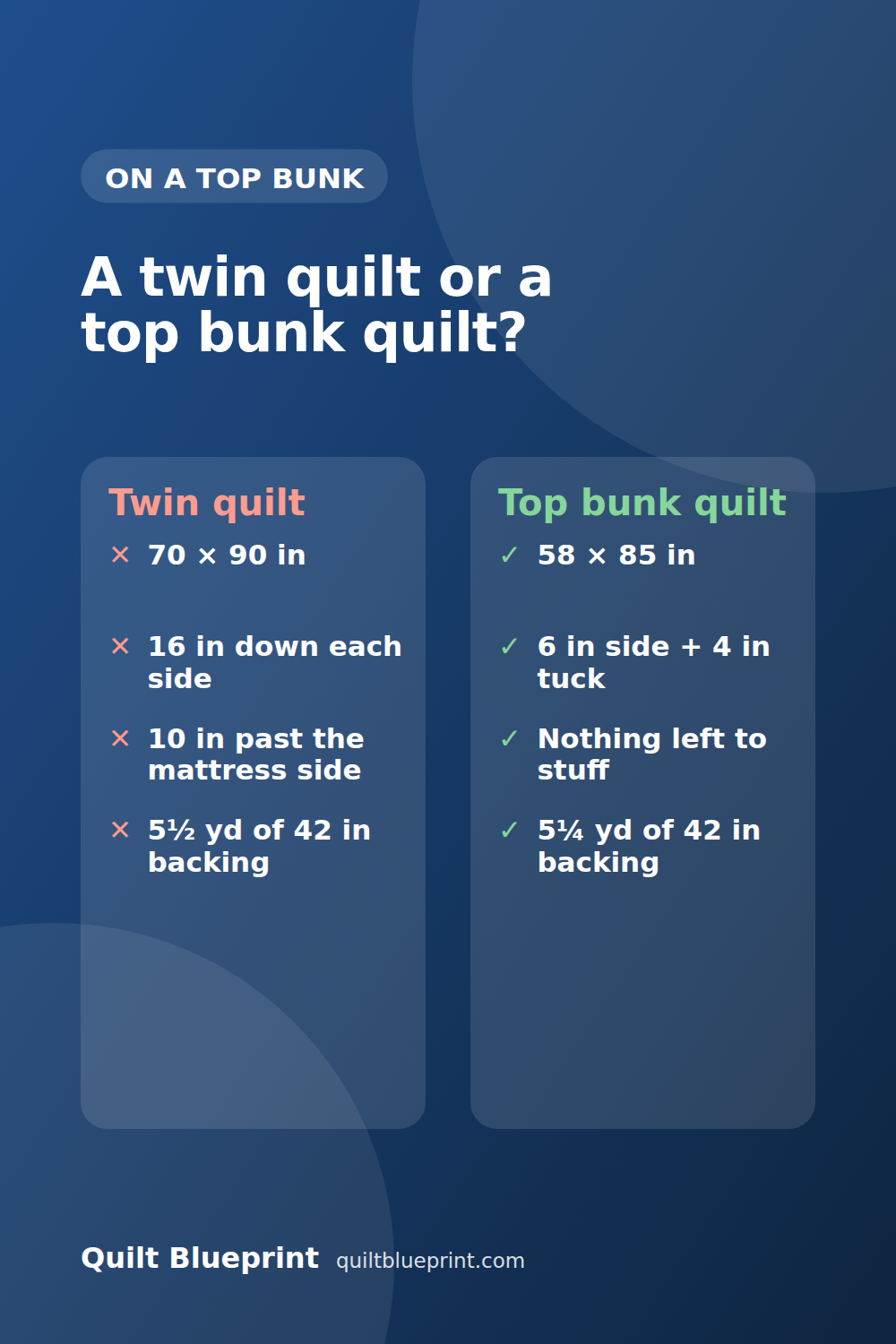
There's a smaller payoff, too. A 58 × 85 in top is about 22% less quilt than a 70 × 90 in twin, so there's less to piece and less to quilt, and the binding is 34 in (86 cm) shorter.
Backing, batting and binding for a pair of bunk quilts
These follow the rules Quilt Blueprint's calculators use: 4 in (10.2 cm) of extra backing and batting on every side, and a binding as long as the edge plus 10 in (25.4 cm).
| What to buy | Top bunk, 58 × 85 in | Bottom bunk, 60 × 87 in |
|---|---|---|
| Backing, 42 in fabric | 2 panels 93 in long: 5¼ yd (4.8 m) | 2 panels 95 in long: 5⅜ yd (4.9 m) |
| Backing, 108 in wide | One piece 66 in long: 1⅞ yd (1.7 m) | One piece 68 in long: 2 yd (1.8 m) |
| Batting | 66 × 93 in: a full batt, or 2⅝ yd (2.4 m) off a 90 in roll | 68 × 95 in: a full batt, or 2¾ yd (2.5 m) off a 90 in roll |
| Binding | 296 in: 8 strips 2½ in wide, ⅝ yd (0.6 m) | 304 in: 8 strips 2½ in wide, ⅝ yd (0.6 m) |
Two twin quilts would take 11 yd (10 m) of 42 in backing. This pair takes 10½ yd (9.6 m). Watch the batting, though. A packaged twin batt is 72 × 90 in (183 × 229 cm), which is 3 in short on the length for the top bunk and 5 in short for the bottom. Buy the full size, 81 × 96 in (206 × 244 cm), or cut from a roll.
If your bunks don't match the chart, the backing calculator, batting calculator and binding calculator take any size you type.
Three ways a bunk bed quilt goes wrong
Planning a twin for the top bunk. A twin's 16 in drop is made for open sides. Up top it ends up stuffed beside the mattress or hung over the rail. Start from the mattress depth instead.
Guessing the mattress depth. A 5 in and an 8 in bunk mattress change the top bunk quilt by 6 in (15.2 cm) across and 3 in (7.6 cm) in length. Measure the one that's actually on the bed.
Making both quilts one size on a twin-over-full. The full underneath is 16 in (40.6 cm) wider than the twin above it. Plan two sizes from the same block and the same border fabric, and they'll still read as a pair.
Questions people ask
Are bunk beds typically twin or twin XL?
Most take a standard twin mattress, 38 × 75 in (97 × 191 cm). Some are twin XL, 38 × 80 in (97 × 203 cm), and a twin-over-full bunk has a full underneath. Measure the mattress before you plan the quilt.
What is the best bedding for a bunk bed?
Bedding sized to the mattress rather than to a bed. On a top bunk that's a quilt that covers the mattress and its sides and tucks under, about 58 × 85 in (147 × 216 cm) for a 6 in twin mattress. The bottom bunk can take a longer drop.
What is the standard size for a bunk bed?
A twin: the mattress is 38 × 75 in (97 × 191 cm), and bunk mattresses are often 6 to 8 in (15 to 20 cm) deep. Twin XL and twin-over-full bunks are made too.
Is an 8 inch mattress too thick for a bunk bed?
It depends on the bunk. The top bunk's guardrails must stand at least 5 in (12.7 cm) above the mattress, checked with the thickest mattress the maker recommends, so read your bed's instructions. If 8 in is allowed, the top bunk quilt is 62 × 87 in (157 × 221 cm).
Sources
- Quilt size chart: standard quilt and mattress sizes (Quilt Blueprint, read 2026-11-12)
- Quilt backing calculator: 4 in a side and ½ in seams (Quilt Blueprint, read 2026-11-12)
- Quilt batting calculator: packaged batting sizes (Quilt Blueprint, read 2026-11-12)
- Quilt binding calculator: 2½ in strips, the edge plus 10 in (Quilt Blueprint, read 2026-11-12)
- Bunk beds business guidance: guardrails on both sides, their tops at least 5 in above the mattress, lower bunks 30 in or less (U.S. Consumer Product Safety Commission, read 2026-11-12)
- Comforters for bunk beds: a twin bunk mattress 38 × 75 in, often 6 to 8 in deep (Biltrite Furniture, read 2026-11-12)
Keep reading
What Size Quilt for a Daybed? The Sum and a Chart, in Inches and cm
What size quilt for a daybed: the mattress, one front drop and a short tuck at the back and arms. A chart for twin and full daybeds in inches and cm.
Quilt Backing Fabric Not Wide Enough? 5 Fixes, Worked Out in Inches and cm
Quilt backing fabric not wide enough? Add a strip 1 in wider than the gap, turn the seams, cut less extra or use 108 in backing. Every sum in inches and cm.
How to Make a Quilt Longer but Not Wider: 4 Ways, Worked Out in Inches and cm
How to make a quilt longer but not wider: borders on the top and bottom only, more rows, or a pillow tuck band. Every cut and yard in inches and cm.