What Size Quilt for a Daybed? The Sum and a Chart, in Inches and cm
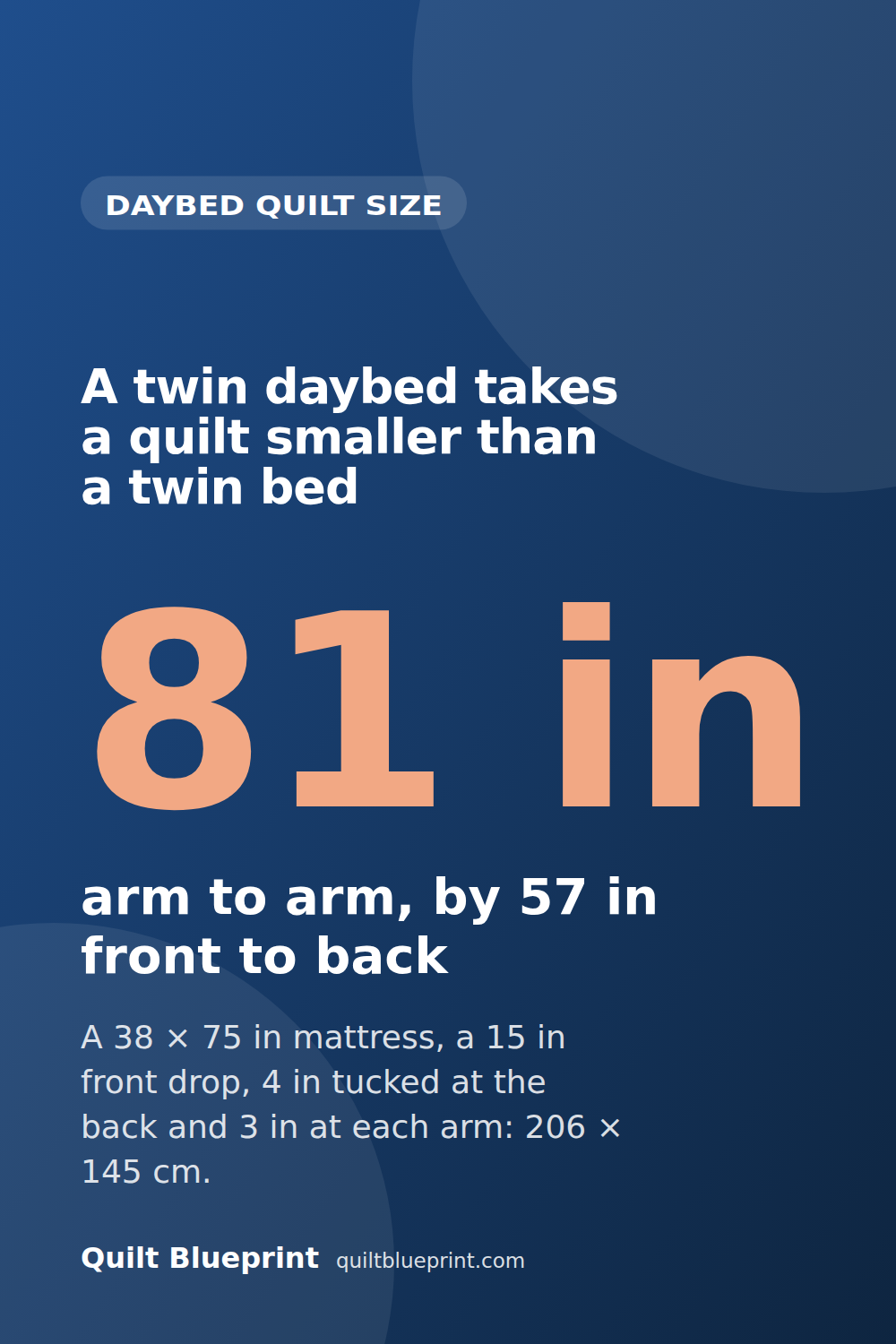
A quilt for a twin daybed is about 81 × 57 in (206 × 145 cm): 81 in from arm to arm, and 57 in from the back rail to the front edge. That's smaller than a twin bed quilt, because a daybed has a back and two arms, so the quilt only hangs down the front. The sum is the mattress, plus one front drop, plus a short tuck at the back and at each arm. A full daybed with the same drop takes 81 × 73 in (206 × 185 cm).
Most daybeds hold a standard twin mattress, 38 × 75 in (97 × 191 cm), and some hold a full, 54 × 75 in (137 × 191 cm). Below is the sum, a chart for three drops, and one daybed quilt worked out from the blocks to the binding.
Why a bed quilt doesn't sit right on a daybed
A bed quilt is planned to hang down three sides: both long sides and the foot. A standard twin quilt is 70 × 90 in (178 × 229 cm), so it drops about 15 to 16 in (38 to 41 cm) over a twin mattress on each side and at the foot. Every standard size is in the quilt size chart.
A daybed sits sideways against a wall. The back rail and the two arms block three of its four edges, so only the long front edge has anywhere to hang. Put a bed quilt on it and the extra has to go somewhere. It bunches behind the mattress, folds up against the arms, or drags on the floor at the front.
A daybed quilt is turned, too. Its long side runs arm to arm, along the wall, and its short side runs from the back rail to the front. Keep that in mind with a directional print or a block that points one way: on a daybed, the top of the quilt is the edge at the back rail.
Is a daybed a twin or a full?
Most daybeds are built for a standard twin mattress, 38 × 75 in (97 × 191 cm). Fewer are made for a full, 54 × 75 in (137 × 191 cm). They're the same mattresses a bed uses, so ordinary sheets fit. It's the quilt and the comforter that don't.
Measure the mattress itself, not the frame. The arms and the back rail add inches the quilt never covers. And a twin XL mattress, at 38 × 80 in (97 × 203 cm), is 5 in (12.7 cm) longer than a twin, which is enough to make a quilt planned for the wrong one look off. A tape across the top and along the front edge settles it.
While the tape's out, take one more number: the drop. Hold the tape at the top front edge of the mattress and measure down to where you want the quilt to stop. That might be just past the mattress, at the bottom of the frame rail, or close to the floor over a trundle.
The daybed quilt sum
Here it is, with the two sides named the way you use a daybed:
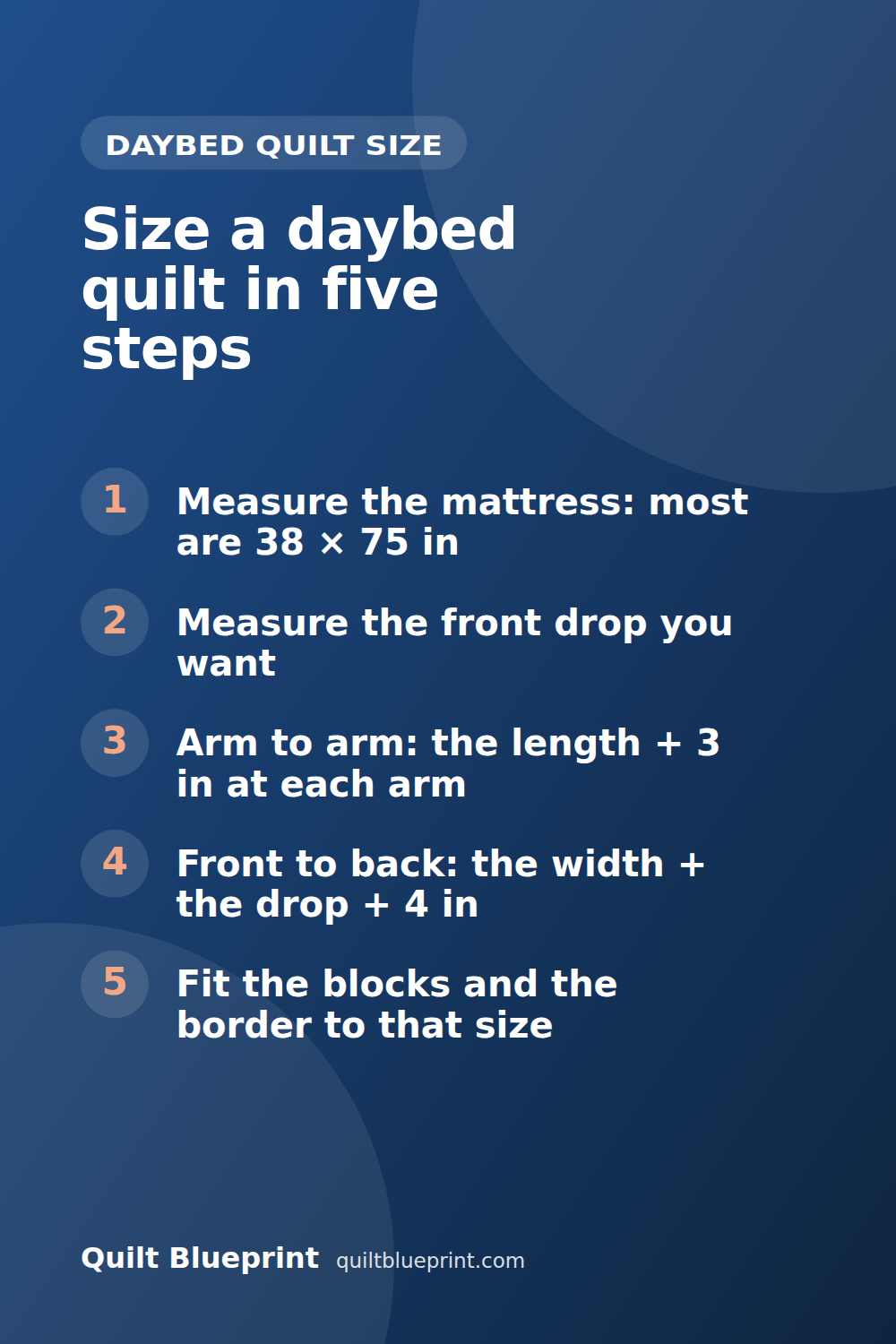
- Arm to arm = the mattress length + a tuck at each arm. For a twin, 75 + 3 + 3 = 81 in (206 cm).
- Front to back = the mattress width + the front drop + a tuck at the back. For a twin with a 15 in (38.1 cm) drop, 38 + 15 + 4 = 57 in (145 cm).
The 3 in (7.6 cm) at each arm and the 4 in (10.2 cm) at the back are tucks, not drops. They slip down between the mattress and the frame, and the back tuck stops the quilt creeping forward every time someone sits on the front edge. If your arms sit tight against the mattress, leave the arm tucks out and make that side 75 in (191 cm).
If the arms are open rails rather than solid panels, the ends can hang like the front. Then arm to arm = 75 + the drop at each end. That's how a shop-bought daybed cover is made, with slits at the corners so it falls around the frame. For a twin it runs about 52 to 55 in by 97 to 100 in (132 to 140 cm by 246 to 254 cm).
Daybed quilt sizes: a chart for twin and full
Here are both daybeds at three drops. All six keep the 3 in (7.6 cm) tuck at each arm and the 4 in (10.2 cm) tuck at the back, so the arm-to-arm side stays at 81 in (206 cm). Only the front-to-back side changes.
| Daybed mattress | Front drop | Quilt, arm to arm × front to back |
|---|---|---|
| Twin, 38 × 75 in | 10 in (25.4 cm) | 81 × 52 in (206 × 132 cm) |
| Twin, 38 × 75 in | 15 in (38.1 cm) | 81 × 57 in (206 × 145 cm) |
| Twin, 38 × 75 in | 22 in (55.9 cm) | 81 × 64 in (206 × 163 cm) |
| Full, 54 × 75 in | 10 in (25.4 cm) | 81 × 68 in (206 × 173 cm) |
| Full, 54 × 75 in | 15 in (38.1 cm) | 81 × 73 in (206 × 185 cm) |
| Full, 54 × 75 in | 22 in (55.9 cm) | 81 × 80 in (206 × 203 cm) |
A 10 in (25.4 cm) drop is the short, tidy one, for a daybed that spends most of the day as a sofa. The 15 in drop matches what a twin bed quilt hangs at the foot of a bed. Go to 22 in or more when there's a trundle or a metal rail you'd rather hide. Check it against your own tape first, though. The drop you measured beats any number in a chart.
Will a twin quilt or a throw work instead?
A twin bed quilt will go on a twin daybed, with some folding. Turn it so the 90 in (229 cm) side runs arm to arm. That's 15 in (38.1 cm) longer than the mattress, so 7½ in (19.1 cm) gets pushed down at each arm. Front to back, its 70 in (178 cm) leaves 32 in (81.3 cm) past the mattress to split between the front and the back.
With a 15 in front drop, that puts 17 in (43.2 cm) behind the mattress. A roll of quilt that thick lifts the back of the mattress and shoves it toward the front, and the front edge ends up lumpy. The other way to use it is a 28 in (71.1 cm) front drop and 4 in at the back, which only works if the frame stands tall enough for a 28 in drop.
A throw has the opposite problem. At 50 × 65 in (127 × 165 cm), its long side is 10 in (25.4 cm) shorter than a twin mattress, so it can't cover the top from arm to arm. It looks lovely folded over the back rail or across one end. It just isn't a daybed quilt.
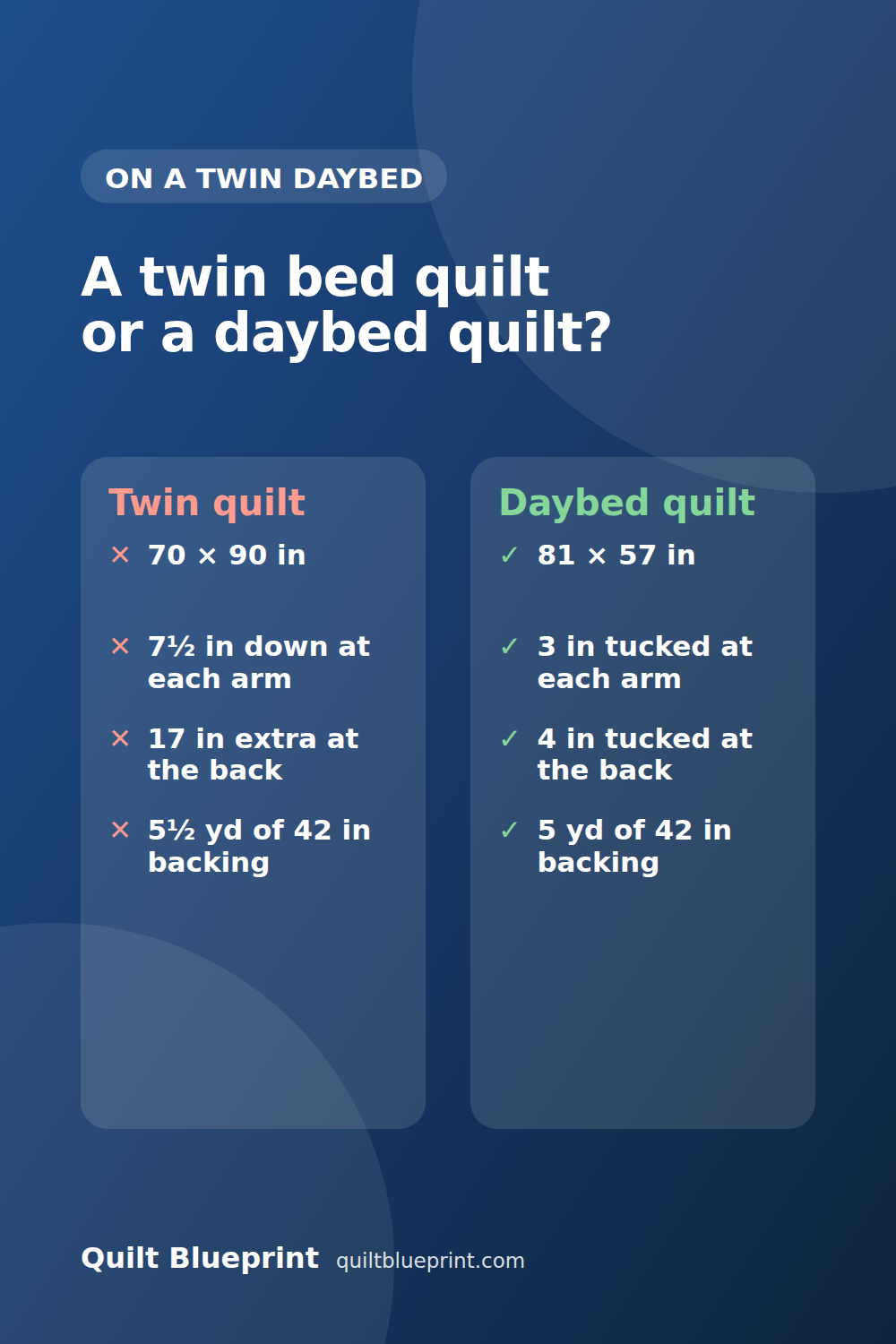
Making it to size has one more small payoff. An 81 × 57 in top is about 27% less quilt than a 70 × 90 in twin: less to piece, less to quilt, and a shorter binding.
Blocks for a daybed quilt: one worked out
Take the twin daybed at a 15 in drop, 81 × 57 in (206 × 145 cm), and a 12 in (30.5 cm) block. Quilt Blueprint fits the blocks first and the border second, and never goes over the size you asked for:
- Blocks: 6 across and 4 down, 24 blocks, which make 72 × 48 in (183 × 122 cm).
- Border: 4½ in (11.4 cm) all round, which brings it to exactly 81 × 57 in.
- Border cuts: strips 5 in (12.7 cm) wide. Two at 48½ in (123.2 cm) for the arm ends go on first, then two at 81½ in (207 cm) for the back and the front.
- Border fabric: 7 strips across 42 in (107 cm) fabric, joined end to end. That's 35 in of fabric, so you buy 1 yd (0.9 m).
A 12 in Ohio star, nine patch or churn dash all come in that size. Twenty-four blocks is a friendly number for a first big quilt, too. A twin bed quilt from the same 12 in blocks takes 35, which is 11 more.
Smaller blocks fit, with a different trade. At 9 in (22.9 cm), it's 9 across and 6 down, 54 blocks, 81 × 54 in (206 × 137 cm). There's no room left for a border, and the front drop comes out 12 in (30.5 cm) instead of 15. At 10 in (25.4 cm), it's 8 across and 5 down, 40 blocks, 80 × 50 in (203 × 127 cm), and the drop shrinks to 8 in (20.3 cm). For this daybed, the 12s fit best.
Backing, batting and binding for a daybed quilt
These are for the 81 × 57 in quilt, with the rules Quilt Blueprint's calculators use: 4 in (10.2 cm) of extra backing and batting on every side, and a binding as long as the edge plus 10 in (25.4 cm).
- Backing: the back is 89 × 65 in (226 × 165 cm). From 42 in quilting cotton, that's two panels, each 89 in (226 cm) long, with the seam running arm to arm: 5 yd (4.6 m). From 108 in (274 cm) wide backing, it's one piece 65 in long: 1⅞ yd (1.7 m).
- Batting: 89 × 65 in fits inside a packaged twin batt, 72 × 90 in (183 × 229 cm), turned sideways. Off a 90 in (229 cm) roll, it's 2½ yd (2.3 m).
- Binding: the edge is 276 in (701 cm), and 10 in more makes 286 in (726 cm). That's 8 strips 2½ in (6.4 cm) wide, cut across the fabric: ⅝ yd (0.6 m).
A twin bed quilt takes 5½ yd (5 m) of backing from 42 in fabric, so the daybed size saves half a yard there as well. If your drop isn't one of the three in the chart, the backing calculator, batting calculator and binding calculator take any size you type.
Three ways a daybed quilt goes wrong
Measuring the frame. The arms and the back rail can add several inches each way. A quilt planned from the frame comes out too long from arm to arm and bunches at both ends. Measure the mattress.
Giving the back a drop. Behind the mattress there's nowhere for a quilt to hang, so anything past a 4 in (10.2 cm) tuck just piles up there. Plan the back as a tuck and put the length into the front.
Planning it the wrong way round. Patterns and calculators list the width first and the length second. On a daybed the long side runs arm to arm, so type 81 as the width and 57 as the length. Then lay the blocks out so anything that points up points to the back rail.
Questions people ask
Is a daybed a twin or twin XL?
Most daybeds take a standard twin mattress, 38 × 75 in (97 × 191 cm), and some take a full, 54 × 75 in (137 × 191 cm). A twin XL is 5 in (12.7 cm) longer at 80 in, so measure your mattress before you plan the quilt.
Do daybeds need special bedding?
Sheets, no: a daybed mattress is a standard size. A quilt or comforter sits better made for it, because the back rail and the arms leave only the front edge to hang. For a twin daybed with a 15 in (38.1 cm) drop, that's about 81 × 57 in (206 × 145 cm).
Is a full size daybed the same as a full size bed?
The mattress is the same, 54 × 75 in (137 × 191 cm). The quilt isn't. A full bed quilt is 84 × 90 in (213 × 229 cm); a full daybed quilt with a 15 in drop is about 81 × 73 in (206 × 185 cm).
What size comforter should I get for a daybed?
One sized for a daybed, not a bed. A twin daybed cover runs about 52 to 55 in by 97 to 100 in (132 to 140 cm by 246 to 254 cm) because it hangs at the ends too. A quilt you make can be smaller: 81 × 57 in (206 × 145 cm) with a 15 in front drop and tucks at the back and arms.
Sources
- Quilt size chart: standard quilt and mattress sizes (Quilt Blueprint, read 2026-11-10)
- Quilt backing calculator: 4 in a side and ½ in seams (Quilt Blueprint, read 2026-11-10)
- Quilt batting calculator: packaged batting sizes (Quilt Blueprint, read 2026-11-10)
- Quilt binding calculator: 2½ in strips, the edge plus 10 in (Quilt Blueprint, read 2026-11-10)
- Answering your most frequently asked questions regarding daybeds: twin 38 × 75 in, full 54 × 75 in, three sides (City Mattress, read 2026-11-10)
- The complete guide to dressing your daybed: a front drop only, daybed cover sizes (Homsee, read 2026-11-10)
Keep reading
How to Make a Quilt Longer but Not Wider: 4 Ways, Worked Out in Inches and cm
How to make a quilt longer but not wider: borders on the top and bottom only, more rows, or a pillow tuck band. Every cut and yard in inches and cm.
Quilt Backing Fabric Not Wide Enough? 5 Fixes, Worked Out in Inches and cm
Quilt backing fabric not wide enough? Add a strip 1 in wider than the gap, turn the seams, cut less extra or use 108 in backing. Every sum in inches and cm.
What Size Quilt for a Bunk Bed? Top and Bottom Bunk Sizes in Inches and cm
What size quilt for a bunk bed: a top bunk takes the mattress, its depth and a short tuck, about 58 × 85 in. Top and bottom bunk charts in inches and cm.