Quilt Backing Fabric Not Wide Enough? 5 Fixes, Worked Out in Inches and cm
If your backing fabric is narrower than your quilt top plus 8 in (20.3 cm), you need more width before it's quilted. There are five ways to get it. Sew a strip down one side, cut 1 in wider than the gap. Put the strip down the middle instead, cut 2 in wider than the gap. Turn the seams so they run side to side. Cut less extra if you quilt at home. Or switch to 108 in wide backing and skip the seams.
Each fix below comes with its numbers in inches and centimetres, the same sums Quilt Blueprint's backing calculator runs for any quilt size and fabric width.
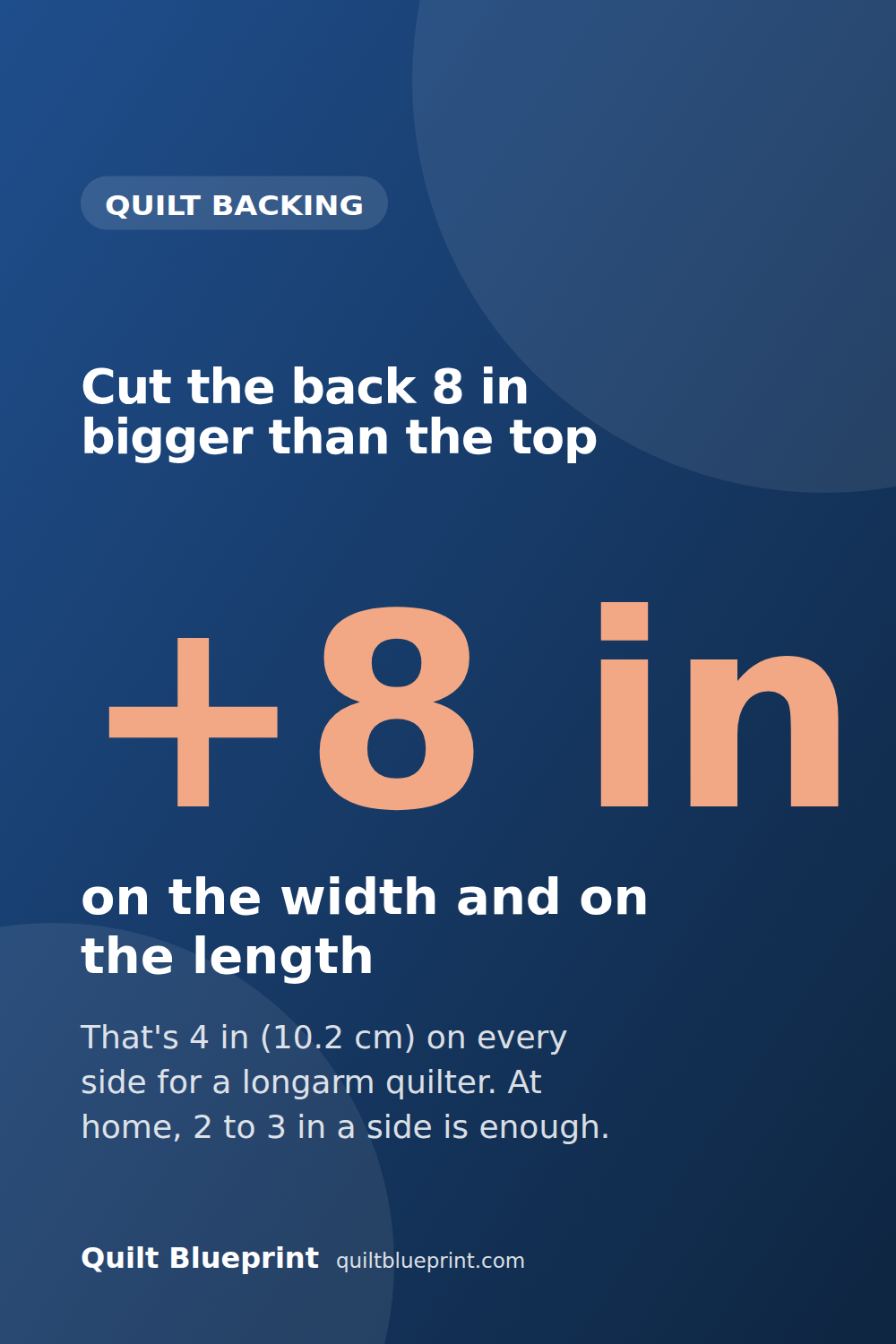
How much wider should quilt backing be?
8 in (20.3 cm) wider and 8 in longer than the top, if a longarm quilter is finishing it. That's 4 in (10.2 cm) on every side.
Quilting pulls the layers in as the stitches go in, so a back cut to the top's exact size ends up short. On a longarm frame the back is pinned to rollers, and the spare at the bottom is what wraps around the take-up roller as the quilting moves down.
On a home machine, 2 to 3 in (5.1 to 7.6 cm) a side is enough, so the back is 4 to 6 in (10.2 to 15.2 cm) bigger than the top each way. If someone else is quilting it, ask them first. Some longarm quilters want more than 4 in, and their number beats this one.
For a throw, the standard 50 × 65 in (127 × 165 cm), that means a back of 58 × 73 in (147 × 185 cm). The quilt size chart has the other standard sizes, and the same 8 in works for every one of them.
Is your fabric wide enough? The widest quilt it covers
Measure your fabric's width with the selvages trimmed off. Quilting cotton is usually about 42 in (107 cm) between the selvages, even when the bolt says 44 in. Then find that width in the table and read across to the widest quilt top it can back.
| Your backing | Its width | 4 in a side (longarm) | 3 in a side (home) |
|---|---|---|---|
| One width of quilting cotton | 42 in (107 cm) | 34 in (86 cm) | 36 in (91 cm) |
| One width of wider cotton | 44 in (112 cm) | 36 in (91 cm) | 38 in (97 cm) |
| 60 in fabric | 60 in (152 cm) | 52 in (132 cm) | 54 in (137 cm) |
| Two widths of 42 in, one seam | 83 in (211 cm) | 75 in (191 cm) | 77 in (196 cm) |
| 108 in wide backing | 108 in (274 cm) | 100 in (254 cm) | 102 in (259 cm) |
| Three widths of 42 in, two seams | 124 in (315 cm) | 116 in (295 cm) | 118 in (300 cm) |
Check the quilt's narrower side against it. You can always turn the fabric, so its length covers the other side.
Two widths of 42 in make 83 in, not 84. Each backing seam is ½ in on each side, the way our calculator sews them, so every join costs 1 in (2.5 cm) of width. Three widths make 124 in, not 126.
So a 36 in (91 cm) baby quilt fits on one width of 42 in fabric at 3 in a side, and doesn't at 4 in. A twin, 70 in (178 cm) wide, fits on two widths with room to spare. A full, 84 in (213 cm) wide, doesn't fit on two widths at either setting, and that's where a backing most often comes up short.
How to make a quilt backing wider: add a strip
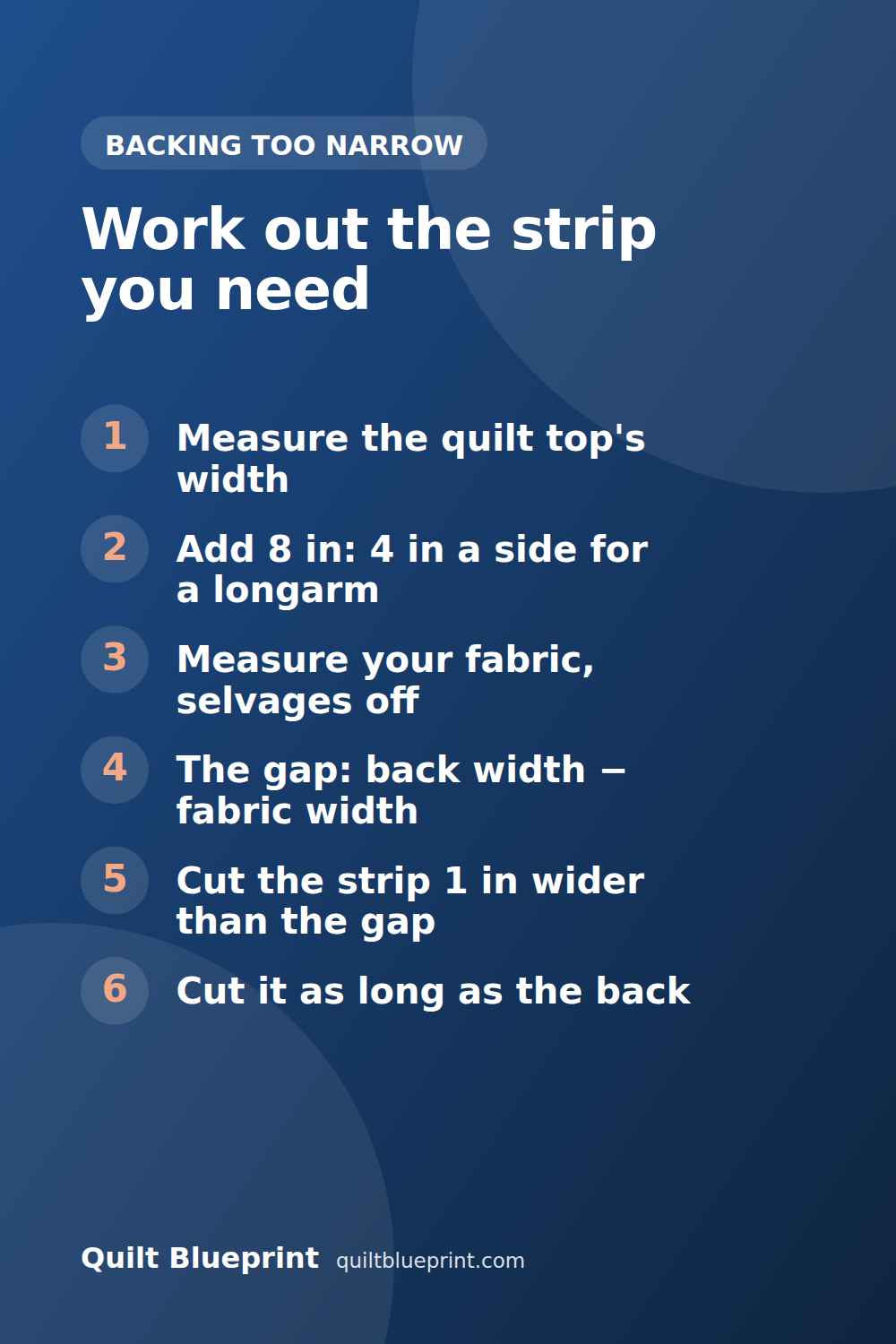
This is the fix most quilters reach for, and the sum is short:
- The back's width = the top's width + 8 in (or + 4 to 6 in at home).
- The gap = the back's width − your fabric's width.
- The strip to cut = the gap + 1 in, for the one seam that joins it.
Say you have one length of a 42 in print for that 50 × 65 in throw. The back needs to be 58 in wide. The gap is 58 − 42 = 16 in, so you cut a strip 17 in (43.2 cm) wide. It runs the full length of the back, 73 in (185.4 cm), and the print is trimmed to that length too.
You don't need a 73 in piece of the second fabric. Cut two strips 17 in wide across a 42 in fabric, join them end to end, and you have 42 + 42 − 1 = 83 in. Trim it to 73. That takes 34 in (86.4 cm) of fabric, so you buy 1 yd (0.9 m). Cut the same strip in one piece down the length and you'd need 2⅛ yd (1.9 m).
A strip down the middle, or a column of leftover blocks
A strip at one edge can look like a mistake. A strip down the middle looks planned. Cut the print in half along its length, into two pieces 21 in (53.3 cm) wide, and sew the strip between them.
That's two seams now, so the strip is the gap + 2 in. For the throw it's 16 + 2 = 18 in (45.7 cm) wide. Two 18 in strips cut across a 42 in fabric take 36 in, so you still buy 1 yd (1 m).
Leftover blocks work the same way. Sew them into a column, add plain fabric at the column's ends to bring it to the back's length, and count the column as part of the strip. If your blocks are cut at 8½ in (21.6 cm), a plain strip 9½ in (24.1 cm) wide sewn beside them makes the 17 in strip: 8½ + 9½ − 1 = 17.
Nobody turns a quilt over to judge the back. A strip of a second fabric is a normal back, not a repair.
When two widths aren't enough: a strip beats a third width
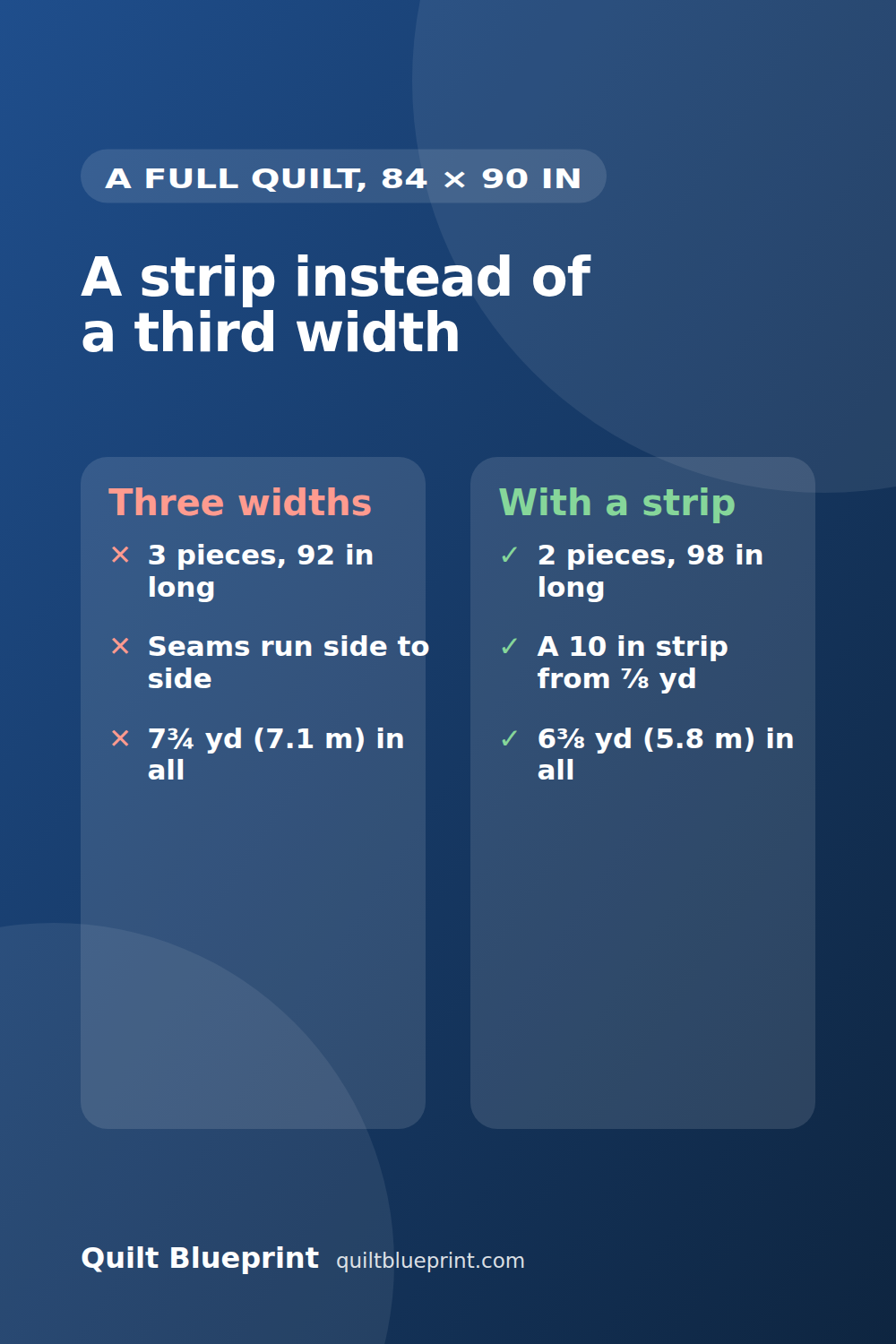
Here's where a strip saves the most fabric. A full quilt is 84 × 90 in (213 × 229 cm), so its back is 92 × 98 in (234 × 249 cm). Two widths of 42 in give 83 in, which is 9 in short.
Buying for three widths, the calculator's answer is 7¾ yd (7.1 m): three pieces 92 in long, with the seams running side to side.
Or keep two widths and add a strip. Two pieces 98 in long take 5½ yd (5 m). The strip is 9 + 1 = 10 in (25.4 cm) wide and 98 in long. Cut three strips 10 in wide across a 42 in fabric and join them: 42 × 3 − 2 = 124 in, trimmed to 98. That's 30 in of fabric, or ⅞ yd (0.8 m).
Together that's 6⅜ yd (5.8 m) instead of 7¾ yd (7.1 m), 1⅜ yd less, and the quilt looks the same from the front.
Turn the seams to run side to side
If you haven't bought the backing yet, which way the seams run changes how much you buy. For a quilt longer than it is wide, seams running side to side often need less.
The throw shows it. Two widths sewn with the seam running up and down are two pieces 73 in long: 146 in, or 4⅛ yd (3.8 m). Turn them so the seam runs across the quilt, and each piece only has to be 58 in long: 116 in, or 3¼ yd (3 m). The calculator compares both ways for every size and gives you the shorter one.
Turning works on wide backing too. A king is 108 × 95 in (274 × 241 cm), so its back is 116 × 103 in (295 × 262 cm), wider than 108 in fabric. Turn the fabric so its 108 in runs down the quilt's 103 in length, and one piece 116 in long, 3¼ yd (3 m), covers it with no seam.
Or cut less extra, if you quilt it at home
If you're quilting it on your own machine and you're only a few inches short, the cheapest fix is to cut less. At 3 in (7.6 cm) a side instead of 4, the back shrinks by 2 in each way.
For a 36 × 36 in (91 × 91 cm) baby quilt, that's the difference between a 44 in back, which takes two widths of fabric and 2½ yd (2.3 m), and a 42 in back, which is one width and 1¼ yd (1.1 m). Half the fabric, from one inch a side.
Keep at least 2 in (5.1 cm) a side, the low end of what a home machine needs, and don't trim the extra for a longarm quilter without asking. A back that's short on a frame can't be fixed by pulling harder.
When 108 in wide backing is the better buy
Wide backing is about 108 in (274 cm) wide, so it backs a top up to 100 in (254 cm) wide in one piece at 4 in a side, and a king once you turn it. No seams and no strips. Here's what each size takes from the calculator, at 4 in a side:
- Throw, 50 × 65 in: 3¼ yd (3 m) of 42 in fabric, or 1⅝ yd (1.5 m) of 108 in.
- Twin, 70 × 90 in: 5½ yd (5 m) of 42 in fabric, or 2¼ yd (2 m) of 108 in.
- Queen, 90 × 95 in: 8¼ yd (7.5 m) of 42 in fabric, as three pieces 98 in long, or 2¾ yd (2.5 m) of 108 in.
- King, 108 × 95 in: 8⅝ yd (7.9 m) of 42 in fabric, or 3¼ yd (3 m) of 108 in, turned.
If the print you love only comes 42 in wide, the strip fixes above use the least of it. If you'd rather sew no seam at all, wide backing is the short way to a queen or a king.
Three ways a backing comes up short
Measuring the bolt, not the fabric. A bolt that says 44 in usually has about 42 in between the selvages. Trim them and measure what's left. If you prewash, measure after the wash.
Forgetting the seam. Two widths of 42 in are 83 in, and three are 124 in. Plan with 84 and 126 and a back that should just fit comes up an inch or two short.
Loading it the wrong way round. A 58 × 73 in back for a throw has a long side and a short side. Mark which edge is the top before it goes to the quilter, so the long side runs down the quilt's length.
Batting is cut bigger than the top by the same amount as the back, so check it against the same numbers. Our batting calculator gives the package to buy or the length off the roll.
Questions people ask
How much wider should quilt backing be?
8 in (20.3 cm) wider and 8 in longer than the quilt top for a longarm quilter, which is 4 in (10.2 cm) on every side. On a home machine, 2 to 3 in (5.1 to 7.6 cm) a side is enough. A 50 × 65 in throw needs a 58 × 73 in (147 × 185 cm) back for a longarm.
How do you make a quilt backing wider?
Sew a strip to one side, cut 1 in wider than the gap between the back you need and the fabric you have, or down the middle, cut 2 in wider. For a 50 in throw on 42 in fabric the gap is 16 in, so a side strip is 17 in (43.2 cm) wide and 73 in (185.4 cm) long.
How do you get fabric big enough for quilt backing?
Sew widths together, or buy 108 in (274 cm) wide backing. Two widths of 42 in fabric make 83 in (211 cm), enough for a top up to 75 in (191 cm) wide at 4 in a side. Wide backing covers a top up to 100 in (254 cm) wide in one piece.
Sources
- Quilt backing calculator: extra on each side, seams and yardage (Quilt Blueprint, read 2026-11-07)
- Quilt size chart: standard quilt sizes in inches and cm (Quilt Blueprint, read 2026-11-07)
- Quilt backing fabric is too short: 8 in larger each way for longarm quilting (Sally Terry, read 2026-11-07)
- Not enough quilt backing fabric: a 42 in usable width, ½ in seams, a strip between two widths (Generations Quilt Patterns, read 2026-11-07)
- How to use less backing fabric on your quilt: 42 in of a 44 in fabric, cross-cut pieces (Joz Makes Quilts, read 2026-11-07)
Keep reading
What Size Quilt Can You Make With a Layer Cake? Every Bed Size, in Inches and cm
What size quilt can you make with a layer cake? One 42-square stack makes a 57 × 66½ in throw. How many layer cakes each bed size takes, in inches and cm.
What Size Quilt Can You Make With 12 Fat Quarters? A Chart From 6 to 40
What size quilt can you make with 12 fat quarters? A 48 × 64 in throw in 8 in squares. A chart for 6 to 40 fat quarters, in inches and cm.
What Size Quilt for a Bunk Bed? Top and Bottom Bunk Sizes in Inches and cm
What size quilt for a bunk bed: a top bunk takes the mattress, its depth and a short tuck, about 58 × 85 in. Top and bottom bunk charts in inches and cm.