What Size Quilt Can You Make With 12 Fat Quarters? A Chart From 6 to 40
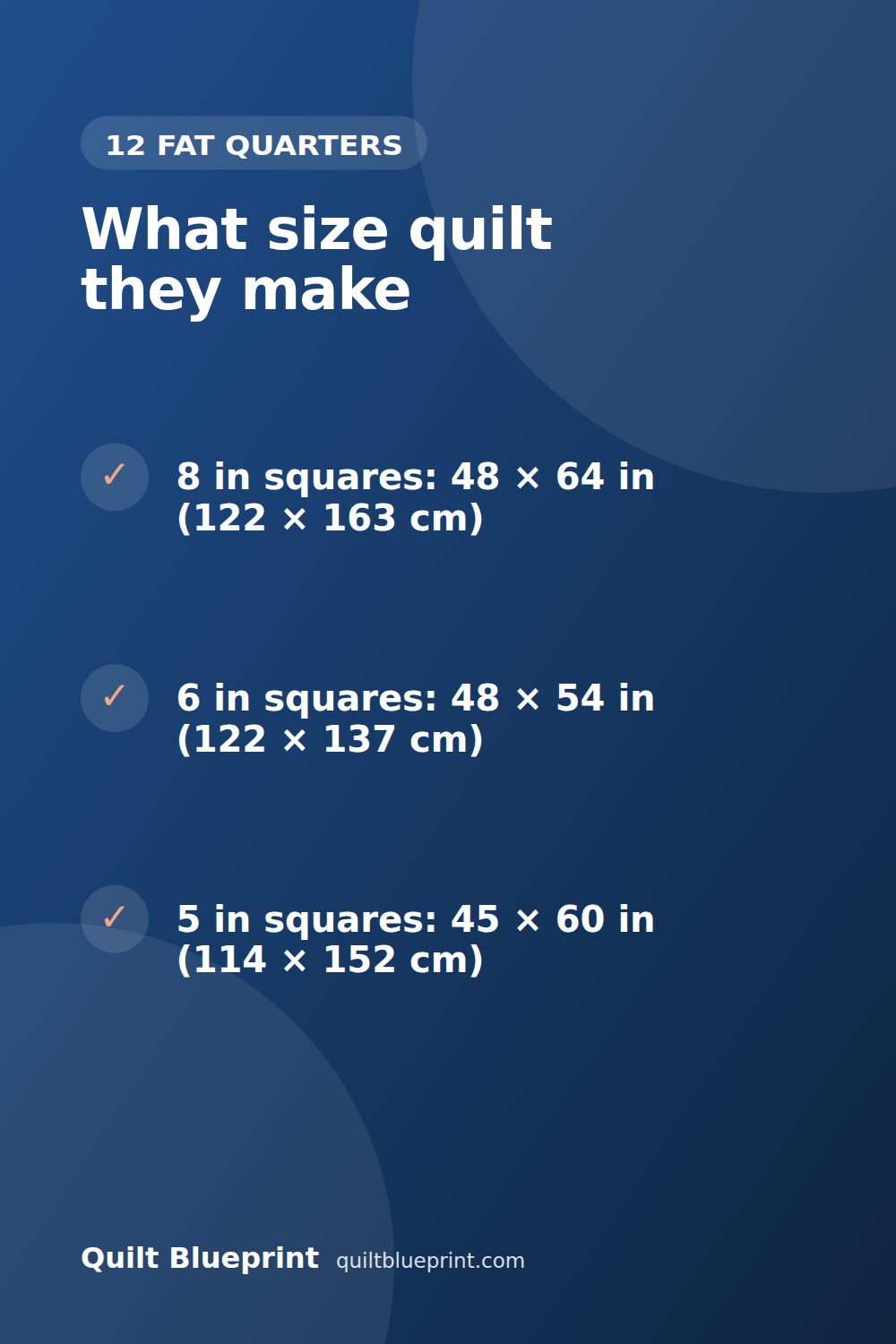
Twelve fat quarters make a 48 × 64 in (122 × 163 cm) throw when you cut them into 8 in squares. Each fat quarter gives you four squares cut at 8½ in, so 12 of them give 48 squares. Lay them 6 across and 8 down and nothing is left over. Cut smaller squares and the same 12 fat quarters make 45 × 60 in (114 × 152 cm) with 5 in squares, or 48 × 54 in (122 × 137 cm) with 6 in squares.
That is the whole answer for 12. The rest of this post is the working, so you can do it for the bundle you actually have: 6 fat quarters, 20, or the 40 you have been saving.
How many squares you can cut from one fat quarter
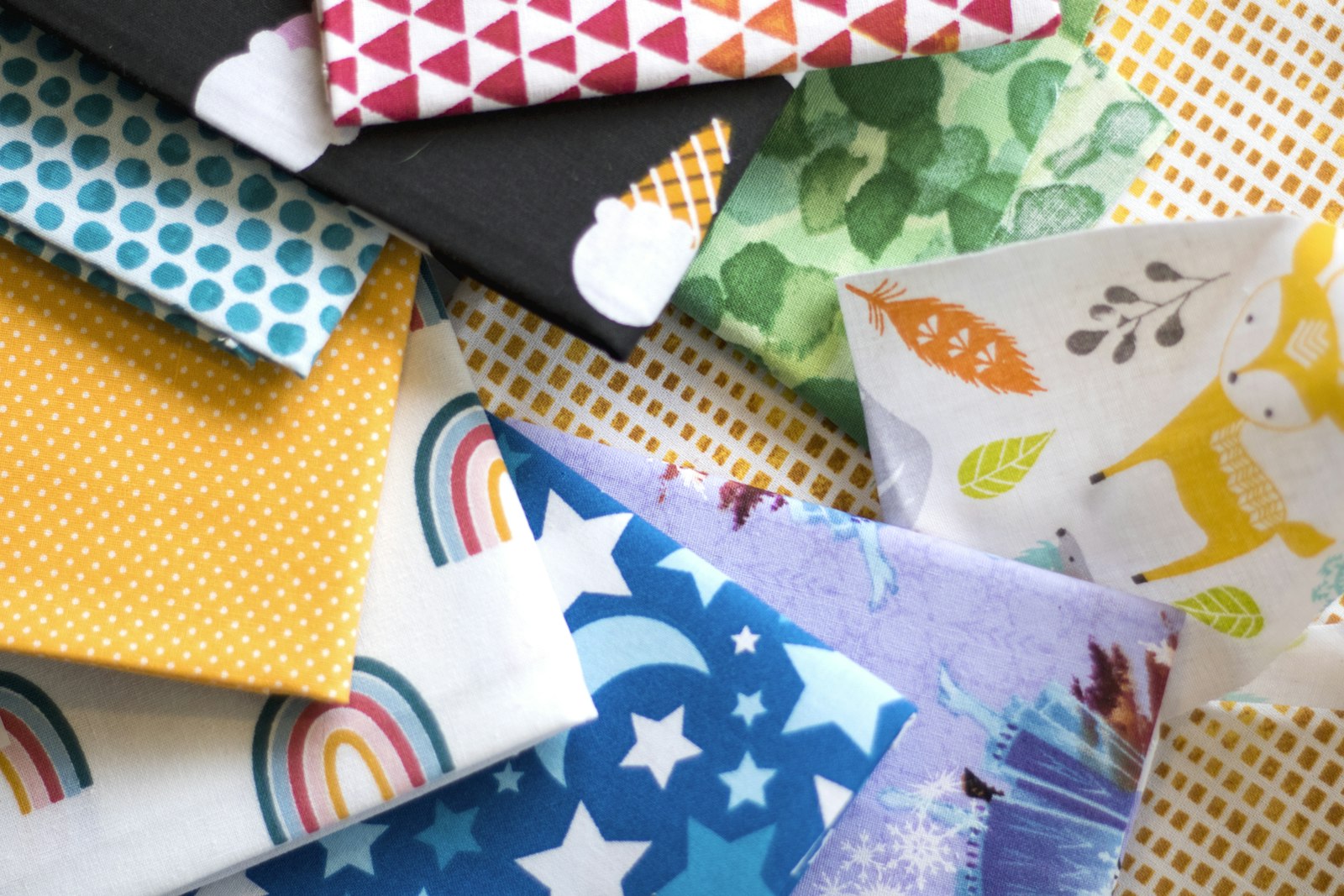
A fat quarter is a quarter yard cut short and wide instead of long and thin. The shop cuts a half yard, 18 in by the width of the bolt (about 42 in), and splits it along the fold, so each piece is about 18 × 21 to 22 in (46 × 53 to 56 cm). Plan with 18 × 21 in (46 × 53 cm). That is the size Quilt Blueprint counts as safe, because you lose a little to the selvage and to straightening the edge, and a fat quarter that measures a full 22 in is a nice surprise rather than the plan.
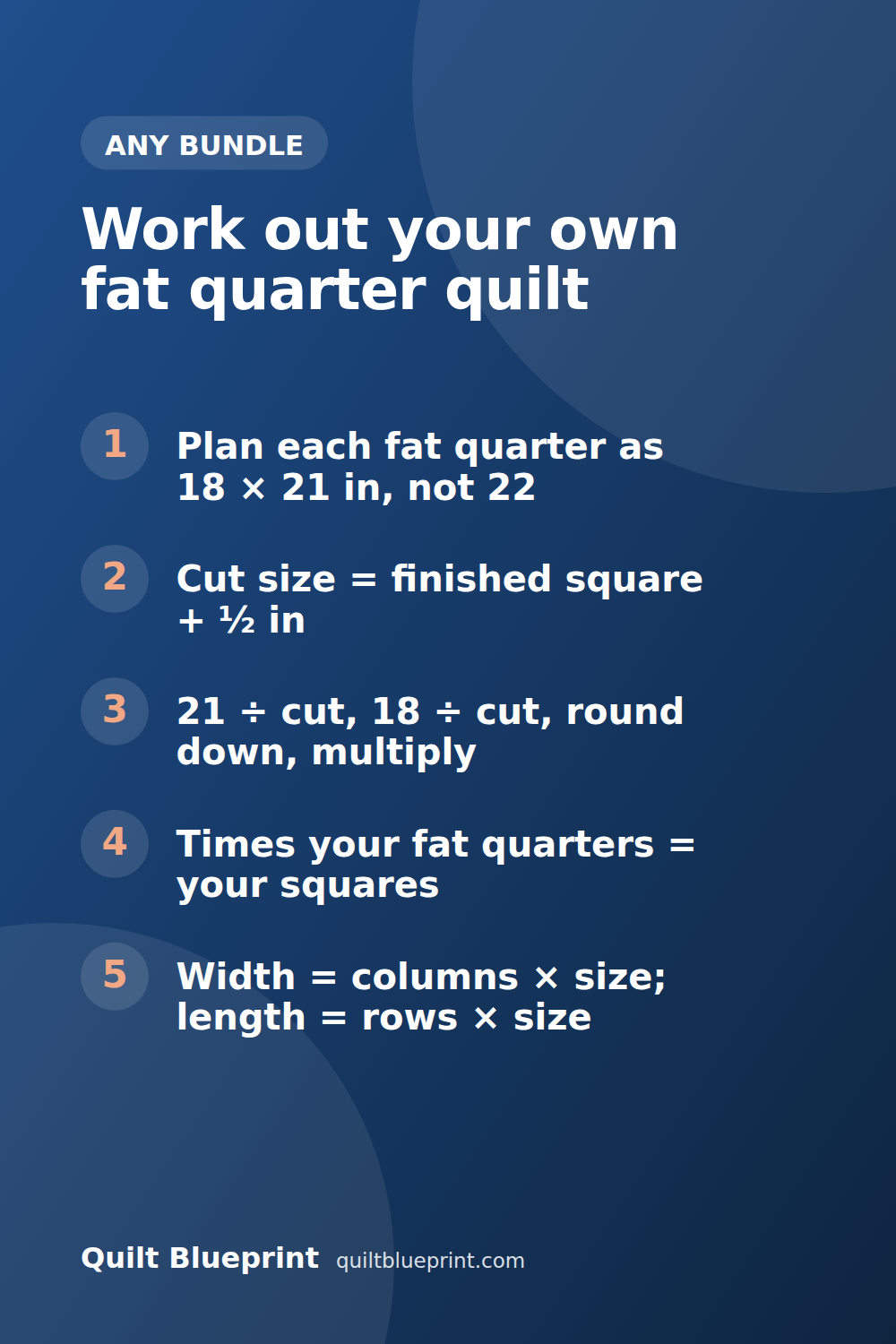
Squares come out of that 18 × 21 in rectangle in a grid. Divide 21 by the cut size and round down, do the same with 18, and multiply. Here is what that gives for the three square blocks on our simple squares page. The cut size always includes the ¼ in seam allowance on each side, so a square cut at 8½ in finishes at 8 in.
| Finished square | Cut size | Squares per fat quarter | Fabric used |
|---|---|---|---|
| 5 in (12.7 cm) | 5½ in (14 cm) | 9 (3 × 3) | 72% |
| 6 in (15.2 cm) | 6½ in (16.6 cm) | 6 (3 × 2) | 67% |
| 8 in (20.3 cm) | 8½ in (21.6 cm) | 4 (2 × 2) | 76% |
"Fabric used" is the share of the 18 × 21 in rectangle that ends up in squares. The rest is offcut along the edges. 8 in squares waste less of a fat quarter than 6 in squares do, so a 6 in quilt from the same bundle can come out smaller.
What size quilt can you make with 6 to 40 fat quarters
Multiply your fat quarters by the squares each one gives, then lay the squares out in rows. The chart below picks the biggest layout that keeps a quilt shape, with the long side no more than 1.4 times the short side. That rules out a 6 × 12 runner when you wanted something to sleep under. Sizes are the finished top, before any border. Each column is a finished square size: 5, 6 or 8 in (12.7, 15.2 or 20.3 cm).
| Fat quarters | 5 in | 6 in | 8 in |
|---|---|---|---|
| 6 | 35 × 35 in (89 × 89 cm) | 36 × 36 in (91 × 91 cm) | 32 × 40 in (81 × 102 cm) |
| 8 | 40 × 45 in (102 × 114 cm) | 36 × 48 in (91 × 122 cm) | 40 × 48 in (102 × 122 cm) |
| 10 | 45 × 50 in (114 × 127 cm) | 42 × 48 in (107 × 122 cm) | 48 × 48 in (122 × 122 cm) |
| 12 | 45 × 60 in (114 × 152 cm) | 48 × 54 in (122 × 137 cm) | 48 × 64 in (122 × 163 cm) |
| 16 | 60 × 60 in (152 × 152 cm) | 54 × 60 in (137 × 152 cm) | 64 × 64 in (163 × 163 cm) |
| 20 | 60 × 75 in (152 × 191 cm) | 60 × 72 in (152 × 183 cm) | 64 × 80 in (163 × 203 cm) |
| 24 | 70 × 75 in (178 × 191 cm) | 72 × 72 in (183 × 183 cm) | 72 × 80 in (183 × 203 cm) |
| 30 | 75 × 90 in (191 × 229 cm) | 72 × 90 in (183 × 229 cm) | 80 × 96 in (203 × 244 cm) |
| 40 | 90 × 100 in (229 × 254 cm) | 90 × 96 in (229 × 244 cm) | 96 × 104 in (244 × 264 cm) |
Some rows leave squares over, because the count doesn't make a neat rectangle. Six fat quarters of 5 in squares give 54 and the 7 × 7 layout uses 49. Ten fat quarters of 6 in squares give 60 and a 7 × 8 layout uses 56, so 4 go in the scrap bin or onto the back. In this chart the spares are never more than 6. Twelve fat quarters come out even in all three sizes, which is part of why 12 is such a handy bundle.
And yes, 10 fat quarters of 8 in squares make a bigger quilt (48 × 48 in) than 10 fat quarters of 6 in squares (42 × 48 in). That is the waste column at work. If you have a fixed bundle and want the most quilt out of it, 8 in squares are the efficient choice of these three.
Which standard quilt sizes those numbers reach
It helps to turn the question around. Here is how many fat quarters each size on our quilt size chart needs in plain squares, using the layout of whole squares that comes closest to the size without going over it.
- Baby, 36 × 36 in (91 × 91 cm): 6 fat quarters of 6 in squares, 6 across and 6 down, hits it exactly.
- Crib, 36 × 52 in (91 × 132 cm): 8 fat quarters of 6 in squares make 36 × 48 in. A 2 in border along the top and bottom would bring it to length, or call it done at 48 in.
- Throw, 50 × 65 in (127 × 165 cm): 12 fat quarters of 8 in squares make 48 × 64 in, or 15 fat quarters of 5 in squares make the full 50 × 65 in with 5 squares spare.
- Twin, 70 × 90 in (178 × 229 cm): 22 fat quarters of 8 in squares make 64 × 88 in. Squares of 5 in reach 70 × 90 in, and that takes 28.
- Full / Double, 84 × 90 in (213 × 229 cm): 28 fat quarters of 8 in squares (80 × 88 in), 32 of 5 in squares (80 × 90 in) or 35 of 6 in squares (84 × 90 in).
- Queen, 90 × 95 in (229 × 241 cm): 31 fat quarters of 8 in squares (88 × 88 in), or 38 of 5 in or 6 in squares.
- King, 108 × 95 in (274 × 241 cm): 36 fat quarters of 8 in squares (104 × 88 in), or 45 of 5 in or 6 in squares.
A fat quarter bundle typically holds 18 to 20 fat quarters. In plain squares that sits between a big throw and a small twin: 20 fat quarters of 8 in squares make 64 × 80 in (163 × 203 cm). For a queen, you're buying two bundles or adding yardage. Those counts assume every square is a fat-quarter print. Once you mix in a background fabric or a border from yardage, the count drops.
What fat quarters can't cover: backing, binding and batting
The fat quarters make the top. The back is a different job, and fat quarters are the wrong shape for it. Quilt Blueprint never counts them toward a backing, because a back needs long, wide pieces and a pile of 18 × 21 in rectangles would mean dozens of seams. Here is the rest of the shopping list for the 48 × 64 in throw, from our backing calculator, binding calculator and batting calculator.
- Backing: 3⅛ yd (2.9 m) of 42 in wide fabric. The back is cut 4 in bigger than the top on every side, so 56 × 72 in. That takes two panels, each 56 in long, joined with one seam across the quilt.
- Binding: ½ yd (0.4 m), cut into six strips 2½ in wide across the fabric. The quilt's edge is 224 in, plus 10 in for the corners and the join.
- Batting: a twin package (72 × 90 in), the smallest common package that covers 56 × 72 in. A crib package (45 × 60 in) is too small. Off a 90 in roll, you'd cut 2 yd.
You can make a scrappy binding from fat quarters if you like the look. Strips cut along the 21 in side are short, so the same quilt needs 13 of them, and one fat quarter gives 7 strips 2½ in wide. That's two fat quarters on top of the twelve. It works fine. It's just a lot of joins.
Three ways a fat quarter count goes wrong
Most of the trouble comes from three small numbers that look harmless on paper.
Planning with 22 in. On an 18 × 22 in plan, a 5½ in square fits 4 times across instead of 3, because 22 ÷ 5½ is exactly 4. That turns 9 squares per fat quarter into 12, and 12 fat quarters into 144 squares instead of 108. But it leaves no room at all. One crooked cut, or a fat quarter that is really 21 in after the selvage comes off, and you're a square short in every piece. Plan with 21 in and the 22nd inch is spare.
Mixing up cut and finished sizes. "5 inch squares" can mean squares cut at 5 in, the size precut packs use, which finish at 4½ in. Those fit 12 to a fat quarter (4 × 3). Twelve fat quarters of them give 144 squares, 12 across and 12 down, and the top finishes at 54 × 54 in (137 × 137 cm). That is not the same quilt as 5 in finished squares, so check which one a pattern or a friend means.
Cutting big squares from small pieces. A 10 in square fits only twice in a fat quarter, one row of two, and that uses 53% of the fabric. The other 47% is a strip about 8 in wide that you then have to find a job for. If you want 10 in blocks, cut them from yardage and save the fat quarters for blocks that fit them.
Turning 12 fat quarters into a plan
Here's the 48 × 64 in throw as a cutting list, start to finish. From each of the 12 fat quarters, cut two strips 8½ × 21 in, then cut each strip into two 8½ in squares. The offcuts are a 1 in sliver and two 4 × 8½ in pieces, so set them aside for something small. That gives 48 squares. Lay them out 6 across and 8 down, move prints around until no two of the same fabric touch, and sew them into 8 rows of 6.
If you want a slightly bigger throw, add a border from yardage. A 3 in finished border takes the top to 54 × 70 in (137 × 178 cm). It also makes the backing and batting bigger, which is why the planner works all of it out together rather than one piece at a time. Start a plan on Quilt Blueprint with a throw and the simple squares block, set the block to 8 in, and it lays the squares out and prints every cut.
Questions people ask
How big of a quilt will 12 fat quarters make?
With 8 in finished squares (cut at 8½ in), 48 × 64 in (122 × 163 cm): four squares per fat quarter, 48 squares in all, 6 across and 8 down. With 5 in squares it is 45 × 60 in (114 × 152 cm), and with 6 in squares 48 × 54 in (122 × 137 cm).
What size quilt can you make with 8 fat quarters?
A crib or baby size. Eight fat quarters of 6 in squares make 36 × 48 in (91 × 122 cm); with 5 in squares, 40 × 45 in (102 × 114 cm); with 8 in squares, 40 × 48 in (102 × 122 cm) with 2 squares spare.
How big of a quilt will 5 fat quarters make?
A small baby quilt or a wall quilt. Five fat quarters of 6 in squares make 30 × 36 in (76 × 91 cm), and 8 in squares make 32 × 40 in (81 × 102 cm).
How big of a quilt can you make with 15 fat quarters?
A throw. With 5 in squares, 15 fat quarters give 135 squares, enough for the full 50 × 65 in (127 × 165 cm) throw with 5 to spare. With 6 in squares, 54 × 60 in (137 × 152 cm).
How big of a quilt can you make with 24 fat quarters?
A large throw or a small twin: 72 × 72 in (183 × 183 cm) in 6 in squares, or 72 × 80 in (183 × 203 cm) in 8 in squares with 6 squares spare. A twin (70 × 90 in) takes 22 fat quarters of 8 in squares (64 × 88 in) or 28 of 5 in squares (70 × 90 in).
How many fat quarters to make a full size quilt?
For a full or double quilt of 84 × 90 in (213 × 229 cm) in plain squares: 28 fat quarters of 8 in squares (80 × 88 in), 32 of 5 in squares (80 × 90 in) or 35 of 6 in squares (84 × 90 in). A border from yardage brings the count down.
Sources
- Quilt size chart: standard quilt sizes in inches and cm (Quilt Blueprint, read 2026-11-04)
- Simple squares quilt block: cut sizes for 5, 6 and 8 in blocks (Quilt Blueprint, read 2026-11-04)
- Quilt backing calculator (Quilt Blueprint)
- Quilt binding calculator (Quilt Blueprint)
- Quilt batting calculator (Quilt Blueprint)
- Fat Quarters FAQs: a half yard (18 × 42 in) cut in half along the fold; a bundle typically holds 18 to 20 (Yellow Umbrella Quilts, read 2026-11-04)
Keep reading
Quilt Backing Fabric Not Wide Enough? 5 Fixes, Worked Out in Inches and cm
Quilt backing fabric not wide enough? Add a strip 1 in wider than the gap, turn the seams, cut less extra or use 108 in backing. Every sum in inches and cm.
What Size Quilt Can You Make With a Layer Cake? Every Bed Size, in Inches and cm
What size quilt can you make with a layer cake? One 42-square stack makes a 57 × 66½ in throw. How many layer cakes each bed size takes, in inches and cm.
What Size Quilt for a Bunk Bed? Top and Bottom Bunk Sizes in Inches and cm
What size quilt for a bunk bed: a top bunk takes the mattress, its depth and a short tuck, about 58 × 85 in. Top and bottom bunk charts in inches and cm.